
Walk into any kitchen store and you will see walls lined with cookware. Sauté pans, saucepans, woks, griddles, crepe pans, tagines, paella pans—the list feels endless. For someone just starting out, it is overwhelming. The good news? You do not need any of that.
After years of cooking at home and talking to professional chefs, I have learned that most home cooks use the same handful of pieces over and over again. The rest just sits in cabinets collecting dust. If you are building your kitchen from scratch or downsizing to what actually matters, five pieces of cookware will cover nearly everything you want to make.
Let me walk you through what those five pieces are, why each one earns its spot, and how to use them without overcomplicating things.
Why Less Cookware Actually Makes You a Better Cook
There is a strange belief that more tools equal better cooking. In reality, the opposite is often true. When you have fewer pots and pans, you learn how each one behaves. You understand how your stainless steel skillet holds heat differently from your nonstick. You figure out how to build a sauce in the same pan you seared meat in. That knowledge beats owning twenty specialized pans you barely touch.
Professional kitchens operate with minimal resources for a reason. Line cooks do not reach for a new pan for every step. They work with what they have, layer flavors, and move efficiently. You can apply that same mindset at home.
Quick Tip: Before buying any cookware, think about what you actually cook in a typical week. If you never bake bread, you do not need a Dutch oven for that. If you make soup only once a month, it’s better to borrow a pot than to buy one. Start with your habits, not your aspirations.
The Five Pieces That Cover It All
These five pieces are not random picks. They were chosen because together they handle sautéing, boiling, simmering, braising, frying, baking, and sauce-making. Here is the breakdown.
| Cookware Piece | Best For | Material |
|---|---|---|
| 10-inch Stainless Steel Skillet | Searing, pan-frying, sautéing, building pan sauces | Tri-ply stainless steel |
| 2-Quart Saucepan with Lid | Rice, grains, small sauces, reheating soup | Stainless steel or clad |
| 8-Quart Stockpot with Lid | Pasta, boiling vegetables, large-batch soups and stocks | Stainless steel |
| 5-Quart Enameled Dutch Oven | Braising, stews, baking bread, oven-to-table dishes | Cast iron with enamel coating |
| 12-inch Nonstick Skillet | Eggs, delicate fish, pancakes, anything that sticks easily | Hard-anodized aluminum with nonstick coating |
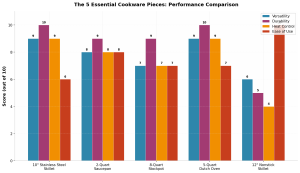
1. The 10-Inch Stainless Steel Skillet
This model is the workhorse. If I could only keep one pan, it would be this one. A good stainless steel skillet does what nonstick cannot: it creates a proper sear. When meat hits a hot stainless surface, it develops a brown crust through the Maillard reaction. That crust is where deep flavor lives. Try getting that in a nonstick pan and you will be disappointed.
A 10-inch size is perfect for cooking one to two portions of protein, a generous amount of vegetables, or a pan sauce after searing. Look for tri-ply construction, which means a layer of aluminum sandwiched between stainless steel. Aluminum conducts heat well; stainless steel provides durability and a non-reactive cooking surface. The combination means even heating without warping.
What to Avoid: Thin, single-layer stainless steel skillets. They heat unevenly, develop hot spots, and warp over high heat. Spend a little more on tri-ply, and you will thank yourself later.
With this pan, you can sear steaks, sauté onions, pan-fry chicken cutlets, toast spices, and make a pan sauce by deglazing with wine or stock. The fond, which consists of those browned bits stuck to the bottom after searing, is liquid gold. Add liquid, scrape it up, and reduce it, and you have a restaurant-quality sauce in minutes.
2. The 2-Quart Saucepan
This saucepan is your everyday pot for small jobs. Need to cook rice for two? Simmer a cup of quinoa? Heat up leftover soup? Make a quick bechamel? The 2-quart saucepan handles all of it.
The size matters here. A 1-quart pot is too small for most tasks. A 3-quart pot is fine but heavier and bulkier than you need for daily use. Two quarts hit the sweet spot. It is large enough to boil pasta for one or two people, small enough to feel manageable, and perfect for tasks where you need controlled, gentle heat.
Get one with a tight-fitting lid. You will use it to trap steam when cooking grains, to keep sauces warm, and to prevent splatter. A helper handle on the opposite side of the main handle is a welcome bonus, especially when the pot is full and hot.
3. The 8-Quart Stockpot
This is the big pot you pull out when you need volume. Pasta for the family. A batch of chicken stock is ready. Corn on the cob for a summer cookout. Boiling potatoes for mashed potatoes. Blanching vegetables.
Some people think an 8-quart pot is too large for a small household. I have a different perspective. You do not fill it to the top every time. Having the extra capacity means you can cook pasta properly — pasta needs room to move in boiling water, or it clumps and cooks unevenly. It means you can make a big pot of soup on Sunday and eat it throughout the week. It means you can boil a whole chicken for homemade stock.
Like the saucepan, go with stainless steel. It is durable, non-reactive, and handles high heat. Enamelled cast iron stockpots exist, but they are heavy and expensive. Stainless steel is the practical choice here.
4. The 5-Quart Enameled Dutch Oven
This is the most versatile piece on the list. A Dutch oven goes from stovetop to oven seamlessly. It holds heat like nothing else. It is heavy, which means it stays in place and distributes heat evenly across the bottom and up the sides.
Use it for braising short ribs or chicken thighs. Use it for no-knead bread, where the preheated pot creates steam that gives you a crackly crust. Use it for chili, for beef stew, for baked beans, for risotto. Use it to fry chicken—the high sides contain splatter better than a skillet.
Enamelled cast iron is the standard here. Brands like Le Creuset and Staub are legendary, but they are expensive. Lodge and Cuisinart make excellent enameled Dutch ovens at a fraction of the price. The enamel coating means you do not have to season the pot like raw cast iron, and it is easier to clean.
Pro Insight: A 5-quart Dutch oven is the ideal size for most households. It is big enough for a whole chicken and small enough to use for everyday tasks. A 7-quart is great if you cook for crowds regularly, but for most people, 5 quarts is the best choice.
5. The 12-Inch Nonstick Skillet
I saved this one for last because it is the most limited—but also the most forgiving. Eggs stick to stainless steel. Delicate fish sticks to stainless steel. Pancakes and crepes stick to stainless steel. A good nonstick skillet solves that problem.
The key word is excellent. Cheap nonstick pans have coatings that scratch, flake, and degrade within a year. Look for hard-anodized aluminum with a PFOA-free nonstick coating. Brands like T-fal, GreenPan, and OXO make reliable options that last several years with proper care.
Here is the thing about nonstick: treat it gently. Do not use metal utensils. Do not crank the heat too high—medium is the max. Do not put it in the dishwasher. Hand wash with a soft sponge. If you abuse a nonstick pan, the coating will fail. If you treat it right, it will serve you well for years.
I recommend a 12-inch size because eggs spread, pancakes need space, and you will appreciate the extra room. A 10-inch nonstick pan feels cramped quickly.
What These Five Pieces Can Actually Do
It is one thing to list five pans. It is another thing to understand the full picture of what they enable. Together, these five pieces cover virtually every cooking method a home cook needs.
Allow me to explain it in practical terms. With just these five pieces, you can make the following:
- Pan-seared salmon with a lemon butter sauce (stainless skillet)
- Fluffy scrambled eggs and crispy bacon (nonstick skillet)
- Homemade chicken noodle soup (stockpot)
- Beef bourguignon (Dutch oven)
- Perfect jasmine rice (saucepan)
- No-knead artisan bread (Dutch oven)
- Stir-fried vegetables with tofu (stainless skillet)
- Creamy mac and cheese (saucepan)
- Braised short ribs over polenta (Dutch oven)
- Boiled pasta with garlic and olive oil (stockpot)
That is breakfast, lunch, and dinner. That is weeknight meals and weekend projects. That is cooking for one or cooking for six. Five pieces. That is it.
How Much Should You Spend?
Cookware pricing varies wildly. You can spend $20 on a skillet or $300. Here is a realistic breakdown of what quality costs for each piece.
Your total investment for all five pieces, buying quality but not luxury, will land somewhere between $300 and $500. That sounds like a lot, but spread across pieces that last a decade or more, it is reasonable. The Dutch oven is the biggest expense. The nonstick skillet is the cheapest and the one you will replace most often.
Budget Strategy: If money is tight, buy the stainless steel skillet and the saucepan first. Add the stockpot next. Save the Dutch oven for a birthday or holiday gift to yourself. To get started, pick up a decent nonstick skillet at a discount store. You can upgrade later.
Caring for Your Cookware So It Lasts
Buying quality cookware is only half the battle. Taking care of it is equally important.
For stainless steel, let the pan preheat before adding oil. This prevents sticking. Do not use steel wool—it scratches. Bar Keepers Friend or a paste of baking soda and water will remove discoloration and restore shine.
For nonstick, never use metal utensils. Never heat an empty pan. Never use high heat. Wash by hand. When the coating starts to degrade—food sticks, and the surface looks scratched or cloudy—replace it. A damaged nonstick coating is not worth the risk.
For enameled cast iron, avoid thermal shock. Do not take a hot Dutch oven and run cold water into it. The enamel can crack. Use wooden or silicone utensils to protect the interior. If food burns on, soak it in warm soapy water rather than scrubbing aggressively.
What You Can Skip Entirely
Knowing what to buy is helpful. Knowing what to ignore is just as valuable. Here are pieces that sound useful but rarely earn their keep in a starter kitchen.
| Cookware Piece | Why You Can Skip It |
|---|---|
| Sauté Pan | A skillet does the same job. The straight sides of a sauté pan are pleasing but not essential. |
| Grill Pan | It does not replicate real grilling. Use your outdoor grill or broiler instead. |
| Wok | Unless you have a powerful gas burner, a home stove cannot generate the heat a wok needs. A large skillet works fine for stir-fries. |
| Double Boiler | Place a heatproof bowl over your saucepan. Same result, no extra storage needed. |
| Specialty Pans (Crepe, Paella, etc.) | Fun to own, but they sit unused 364 days a year. Borrow or improvise if the rare occasion arises. |
Final Thoughts
Building a kitchen does not have to be expensive or complicated. The cookware industry wants you to believe you need a different pan for every dish. You do not. Five well-chosen pieces will carry you through years of cooking, from your first scrambled eggs to your first dinner party.
Start with quality over quantity. Learn how your pans behave. Cook often. The rest will follow.