
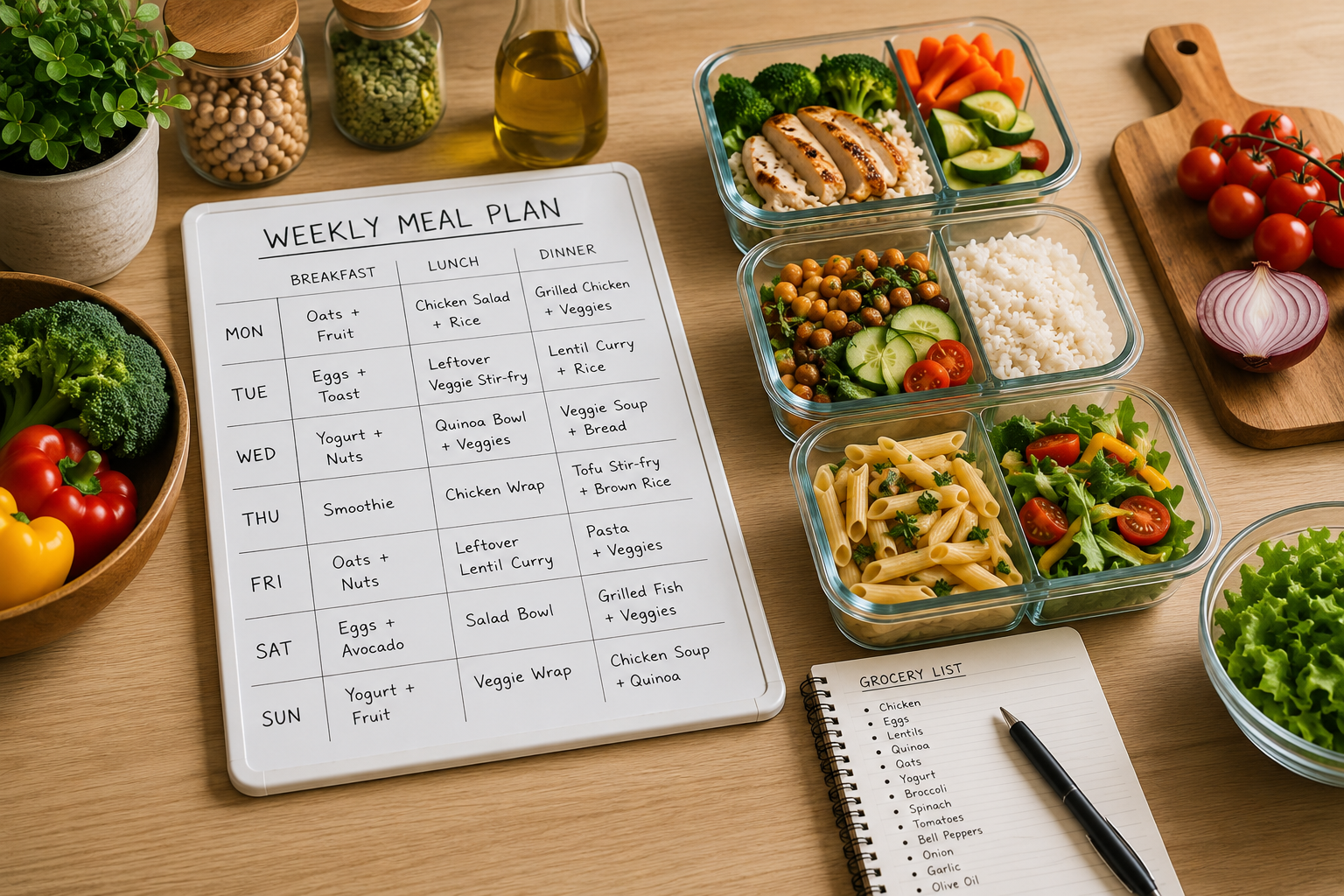
A weekly meal routine is useful for a reason that has little to do with having a perfectly organized refrigerator or cooking every meal from scratch. It provides a clear structure for the week. Without some kind of structure, meals can become a series of last-minute decisions: ordering food because nothing was planned, discovering that an ingredient has gone unused, cooking too much on one evening, or realizing at 6 p.m. that dinner still needs to be figured out.
A balanced routine does not mean assigning an elaborate recipe to every day. In fact, that approach often makes meal planning harder to maintain. A workable week usually includes a mixture of freshly cooked meals, leftovers, quick options, simple preparation, and enough flexibility for plans to change. The aim is to make cooking fit into the week you actually have rather than trying to force the week around an ideal meal plan.
Start With the Shape of the Week
Before choosing meals, look at the week itself. Some evenings may offer plenty of time for cooking, while others may be filled with work, school, appointments, commuting, or other commitments. Treating every day as if it offers the same amount of time is one of the easiest ways to create a meal plan that fails by Wednesday.
Instead, identify the natural rhythm of the week.
Maybe Monday is usually tiring, Tuesday is more manageable, Wednesday has a late commitment, Thursday offers more time, and the weekend is less predictable. The exact pattern does not matter as much as recognizing it.
Match cooking effort to available time
A useful weekly routine might look something like this:
| Type of day | Suitable meal approach |
|---|---|
| Very busy | Quick meal or planned leftovers |
| Normal | Standard home-cooked dinner |
| More relaxed | Longer recipe or cooking project |
| Unpredictable | Flexible pantry or freezer meal |
| End of week | Leftovers or ingredient-use meal |
This simple matching process prevents a common problem: scheduling the most demanding meal for the evening when you are least likely to want to cook it.
Decide How Often You Actually Want to Cook
Not every household needs seven separate cooking sessions. Some people enjoy cooking daily. Others would rather cook three or four times and rely on leftovers between those sessions.
Neither approach is inherently better.
The important question is how much cooking fits comfortably into your normal week. If cooking every night feels exhausting, building a routine around fewer cooking sessions can make home meals much easier to sustain.
For instance, a single substantial cooking session can yield dinner and enough food for another meal. Another evening can be reserved for a quick dish, while a third can involve something more involved.
The routine becomes more efficient when one cooking session has value beyond the single meal being served that night.
Build Meals Around What Can Carry Over
Leftovers are not merely what remains after dinner. They can be deliberately incorporated into the structure of the week.
A roasted chicken might become part of another meal. Cooked grains can support a quick bowl later. Extra roasted vegetables can be reheated, folded into eggs, added to a grain dish, or served alongside another protein.
This does not mean eating identical leftovers several nights in a row. The more useful approach is to think about components that can move between meals.
Cook once, use differently
Suppose you prepare a batch of roasted vegetables on Sunday. On the first night, they might accompany a protein and grain. Later in the week, some can be added to a wrap or mixed into another dish.
The cooking work happens once, but the food does not have to appear on the plate in exactly the same form.
That makes leftovers feel more intentional and reduces the sense that the same dinner is being repeated.
Give Grocery Shopping a Clear Purpose
A weekly meal routine becomes easier when shopping follows the meals rather than happening independently of them.
Instead of filling a cart with ingredients that seem useful, start by identifying the meals you expect to make. Then check what is already available at home before creating the shopping list.
This reduces the chance of buying duplicates or ingredients for meals that never happen.
A practical weekly list can be organized around the way you actually shop:
- Fresh produce
- Proteins
- Grains and other staples
- Dairy or alternatives
- Pantry ingredients
- Items needed for specific meals
The categories are less important than making sure the list connects to the meals planned for the week.
Leave room for ingredients with multiple uses
Ingredients become easier to manage when they can work across several meals.
A bunch of herbs, for example, does not need to be purchased for one isolated recipe. Vegetables, grains, sauces, proteins, and pantry staples can similarly appear in different meals without making those meals feel identical.
This can reduce waste while also making the grocery list less complicated.
Don’t Schedule Seven Perfect Dinners
One of the biggest weaknesses of rigid meal plans is that they assume every planned dinner will happen exactly as expected.
Real weeks rarely behave that way.
You may work late, have unexpected plans, receive an invitation, or simply decide that the meal you planned no longer sounds appealing. A routine that has no room for these situations becomes frustrating very quickly.
Instead, build in flexibility from the beginning.
A week might contain five planned meals and two flexible spaces. Those spaces could be used for leftovers, freezer food, a very quick dinner, eating out, or ingredients that need to be used.
The empty space is not a failure in the plan. It is what makes the plan survivable.
Use a Midweek Check Instead of Replanning Everything
You do not necessarily need to review the entire meal plan every day. A short check in the middle of the week can prevent small problems from becoming larger ones.
Look at what has already been eaten, what ingredients remain, and which foods need attention.
Maybe the vegetables you bought are more abundant than expected. Perhaps Tuesday’s dinner produced more leftovers than planned. Maybe a meal was skipped and can simply move to Thursday.
A five-minute review can be enough to adjust the remaining meals without rebuilding the entire week.
Ask three practical questions
A useful midweek check can be as simple as:
- What food needs to be used soon?
- Which planned meal no longer fits the schedule?
- What is the easiest way to use what is already available?
These questions keep the routine connected to reality.
Balance Effort Across the Week
A good meal routine should not require the same amount of work every day.
If Monday involves a complicated recipe, Tuesday might rely on leftovers. If Wednesday is particularly busy, dinner can be something quick. A more relaxed weekend evening can then provide an opportunity for a longer cooking session.
This creates a rhythm rather than a repetitive workload.
It also makes cooking feel less demanding because the difficult tasks are spread out rather than stacked together.
Think in terms of effort, not just meals
Two meals may take very different amounts of time even if both are technically “home-cooked.”
One might involve chopping several ingredients, preparing a sauce, cooking multiple components, and cleaning several pans. Another might require one skillet and a few basic ingredients.
When building a weekly routine, consider preparation and cleanup as part of the meal’s total effort.
Make Preparation Work for the Week Ahead
Meal preparation does not have to mean spending an entire Sunday cooking seven complete dinners.
Often, smaller preparation tasks are more useful.
You might wash and cut vegetables, cook a grain, prepare a sauce, portion ingredients, or simply organize the refrigerator so the foods you intend to use are easy to see.
These small actions can remove friction from later cooking.
The best preparation is not necessarily the preparation that saves the most cooking time on paper. It is the preparation that makes you more likely to cook when you are tired.
Keep One or Two Emergency Meals Available
Every weekly routine benefits from a fallback.
An emergency meal is not necessarily a frozen dinner or packaged food. It can be any simple combination of ingredients that can become dinner with little planning.
Examples might include eggs with toast and vegetables, a quick pasta dish, a grain bowl, soup from the freezer, or another dependable option that uses ingredients you usually keep available.
The point is not culinary ambition. It is about having something that falls between “cooking an elaborate dinner” and “ordering whatever is easiest.”
The emergency meal should be genuinely easy
If your backup meal requires seven ingredients that you only buy for that specific dish, it is not much of a backup.
Choose something familiar and forgiving. It should be possible to prepare when your energy is low and your schedule has already gone off track.
Use Leftovers Before They Become a Problem
Leftovers can save time, but only when they are visible and planned.
A container pushed behind several other foods can easily become forgotten. Keeping leftovers in clearly identifiable containers and placing foods that need attention where they are easy to see can make a surprising difference.
It also helps to think ahead about when the leftovers are likely to be eaten.
If Tuesday’s dinner produces enough food for another serving, decide whether that serving is likely to become Wednesday’s lunch, Thursday’s dinner, or part of another meal.
The goal is not to fill the refrigerator with containers. It is to make each cooking session useful.
Don’t Let Variety Become Waste
Variety is valuable, but constantly buying ingredients for completely unrelated meals can create unnecessary waste.
A weekly routine can contain different meals while still allowing certain ingredients to overlap.
For example, several meals might use the same herbs, vegetables, grains, or pantry staples in different combinations. This makes shopping more efficient without forcing every meal to taste alike.
There is a useful middle ground between eating the same thing repeatedly and buying a completely different collection of ingredients every day.
Consider Cleanup When Planning Dinner
The cooking itself is only part of the evening.
A meal that takes 20 minutes to cook but leaves a sink full of dishes may feel more demanding than a meal that takes slightly longer but uses one pan.
This is particularly important on busy days.
When choosing meals for a weekly routine, consider the number of pans, cutting boards, utensils, and serving dishes involved. You do not need to avoid complicated cooking altogether, but it helps to place high-cleanup meals on days when you have enough time and energy.
Let the Routine Change With the Season
A weekly meal routine does not need to remain identical throughout the year.
The foods that make sense in a hot summer week may not be the same foods you want during colder months. Seasonal produce can also change what is affordable, available, and appealing.
You can keep the basic structure while changing the meals.
The routine might remain:
cook → leftovers → quick meal → cook → flexible meal
while the actual food changes with the season.
This makes the system stable without making it stale.
Make the Routine Visible
A meal plan that exists only in your head is easy to forget.
It does not need to be elaborate. A note on the refrigerator, a simple calendar, or a basic digital list can be enough.
What matters is that everyone who needs to know the plan can see it.
A visible plan also reduces repeated conversations about dinner. Instead of asking what is being cooked every afternoon, household members can check the week’s structure themselves.
Build Around Real Appetite, Not Just Nutrition on Paper
Balance is not only about putting different food groups into a schedule. It also involves creating meals that people will actually want to eat.
A beautifully organized plan is not useful if several meals are consistently unpopular.
Pay attention to patterns. Which meals disappear quickly? Which produce leftovers that nobody wants? Which recipes are technically successful but never exciting enough to make again?
Those observations can improve the routine more effectively than endlessly searching for new recipes.
The goal is to create a week that feels satisfying as well as organized.
What to Do When the Week Falls Apart
Eventually, a carefully planned week will go completely off schedule. That is normal.
The mistake is assuming that a disrupted Tuesday requires rebuilding the entire plan.
Instead, look at what remains. Move meals rather than deleting them. Use the flexible space. Freeze something if appropriate. Turn leftovers into a different meal. If an ingredient needs to be used quickly, let that ingredient influence the next dinner.
A resilient routine bends instead of breaking.
This is one of the biggest differences between a practical meal system and a plan created only to look organized.
A Simple Weekly Structure to Start With
If you are unsure where to begin, keep the first version deliberately simple.
Choose three or four meals that you are comfortable cooking. Add one meal that uses leftovers or previously prepared components. Keep one quick fallback meal available and leave at least one evening flexible.
For example:
| Day | Role |
|---|---|
| Monday | Simple home-cooked meal |
| Tuesday | Leftovers or quick variation |
| Wednesday | Freshly cooked meal |
| Thursday | Easy or emergency meal |
| Friday | Flexible evening |
| Saturday | More involved cooking |
| Sunday | Leftovers and preparation for the week |
This is only a framework, not a rulebook. The days can be rearranged around your schedule.
What matters is the balance between cooking effort, leftovers, convenience, and flexibility.
Let the Routine Become Familiar
A useful weekly meal routine should require less thought over time, not more.
After several weeks, you should begin to recognize which meals belong on busy days, which ingredients tend to get wasted, how much food your household actually eats, and which preparation tasks genuinely make later cooking easier.
That knowledge becomes part of the routine.
You no longer have to design every week from nothing. You make small adjustments based on what happened during the previous one.
This is where a meal routine becomes valuable. It stops being a planning exercise and becomes a practical household habit.
The Best Routine Is the One That Survives an Imperfect Week
There is no prize for creating the most detailed meal calendar or cooking the largest number of homemade meals.
A balanced weekly routine is successful when it reduces unnecessary work while still leaving room for normal life. It accounts for busy evenings, makes leftovers useful, keeps shopping connected to actual meals, and gives you a fallback when plans change.
Start with fewer cooking commitments than you think you can handle. Give leftovers a deliberate place. Reserve demanding recipes for days that can support them. Keep simple ingredients available for unexpected evenings, and review the plan rather than rebuilding it whenever something changes.
The result should feel less like following a schedule and more like having a reliable path through the week. You still decide what sounds good, you still cook differently from time to time, and you can still change your mind. The difference is that you no longer have to come up with a new dinner idea every evening.
Frequently Asked Questions
How many meals should I plan for a week?
You do not necessarily need seven completely different meals. Many households find a combination of three to five cooked meals, leftovers, quick options, and flexible evenings easier to maintain. The right number depends on how often you want to cook, how many people you are feeding, and how comfortable your household is with leftovers.
Should I cook all my meals for the week at once?
Not necessarily. Preparing every meal at once can be useful for some people, but it is not required for a balanced weekly routine. Smaller preparation tasks, such as washing produce, cooking a grain, preparing a sauce, or portioning ingredients, can provide useful support without turning one day into a full cooking session.
How should I plan meals when my schedule changes often?
Build flexibility into the week rather than trying to predict every change. Keep a couple of quick meals available, use leftovers strategically, and avoid assigning complicated recipes to evenings that are already unpredictable. A flexible routine is generally easier to maintain than a highly detailed schedule.
How can I prevent leftovers from being wasted?
Give leftovers a planned place in the week and keep them visible in the refrigerator. Before shopping again, check what needs to be eaten soon. You can also prepare foods that work in more than one meal rather than cooking large quantities of dishes that are difficult to reuse.
Is meal preparation necessary for a weekly meal routine?
No. Meal preparation can make cooking easier, but it does not need to involve preparing complete meals in advance. Even small tasks such as chopping vegetables, preparing a sauce, or organizing ingredients can reduce the work required later.
What should I do if my planned dinner no longer sounds appealing?
Change it. A meal routine should provide structure, not force you to eat something you no longer want. Move the planned meal to another day, use a flexible option, or choose another meal that fits the ingredients and time available. The plan should serve your household rather than the other way around.