
⏱ Reading time: 8 minutes | 🔄 Updated: July 7, 2026
I moved into my first apartment alone at twenty-four, and I made the same mistake everyone makes. I bought groceries like I was feeding a family of four. Fresh vegetables wilted in the crisper. Bread grew mold before I finished the loaf. Chicken breasts sat in the freezer so long they developed freezer burn armor. I was spending money on food I threw away, and the guilt made me order takeout instead.
Cooking for one is a different skill than cooking for a group. The rules change. Recipes written for four servings become math problems. Bulk buying backfires. Motivation disappears when the only person you are feeding is yourself. But here is what I learned after years of solo cooking: it does not have to be depressing, expensive, or wasteful. With the right strategies, cooking for one becomes efficient, satisfying, and even enjoyable.
These seven strategies are not about meal prepping fourteen identical containers on a Sunday afternoon. They are not about eating the same thing for five days straight. They are realistic approaches that respect your time, your budget, and the fact that sometimes you just want a bowl of cereal for dinner, and that is okay.
Strategy 1: Embrace the Egg
If you are cooking for one, eggs are your best friend. They are portioned by nature. They cook in minutes. They work for breakfast, lunch, and dinner. They are cheap, nutritious, and endlessly versatile. A fried egg on toast with hot sauce is a legitimate meal. A frittata made with whatever vegetables are about to turn is a clean-out-the-fridge victory. A soft-boiled egg dropped into instant ramen elevates it from dorm food to something respectable.
The beauty of eggs is that you do not need a recipe. You need a method. Learn to scramble well, fry sunny-side up, make an omelette, and soft-boil. Those four techniques give you dozens of meals without ever opening a cookbook.
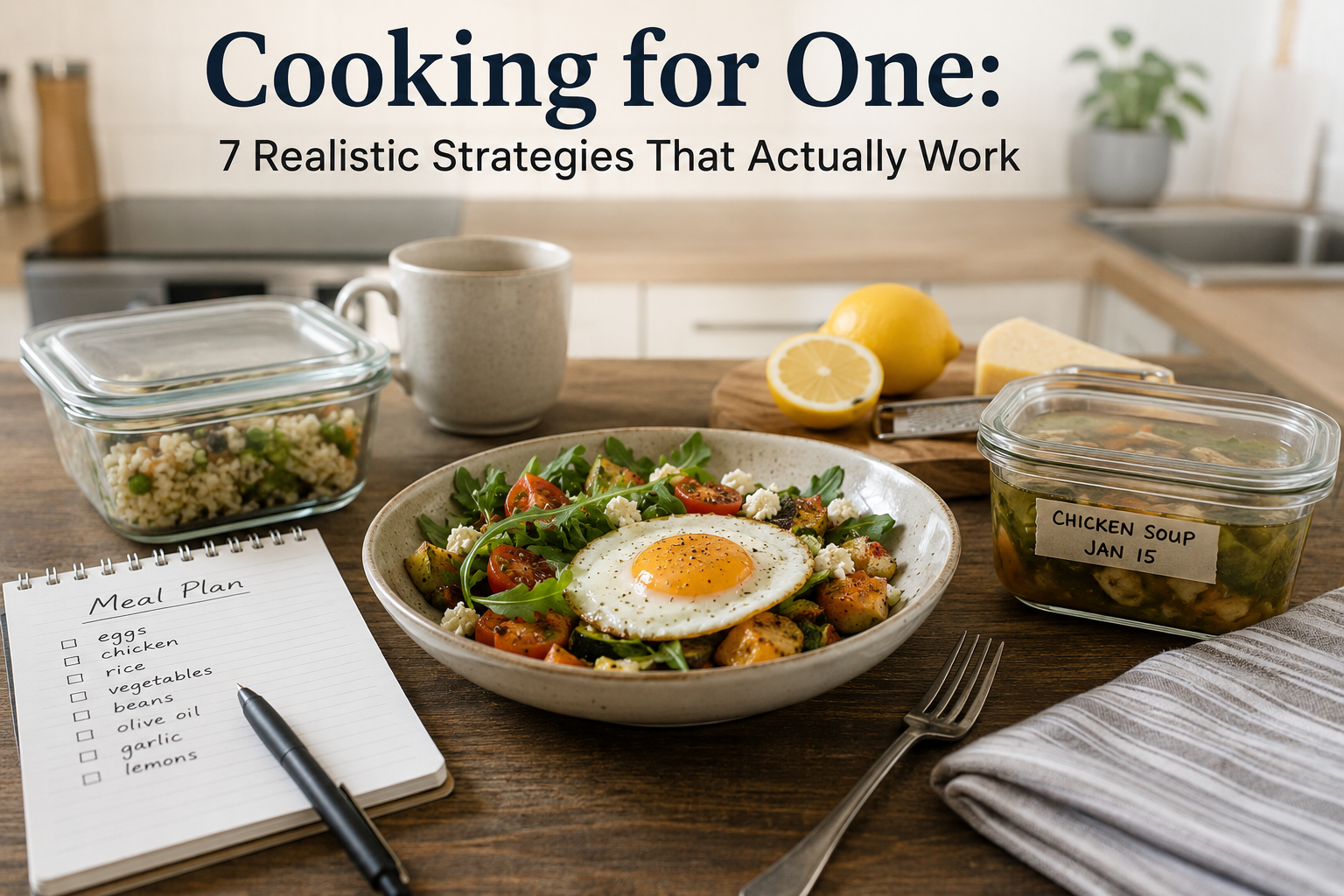
The Egg Dinner Formula: Sauté whatever vegetables you have. Add a protein if you want—leftover chicken, canned beans, or a slice of ham. Crack two eggs over the top, cover the pan, and cook until the whites set. Season with salt, pepper, and whatever herbs or cheese you have. Dinner is served in fifteen minutes, and you only dirtied one pan.
Strategy 2: Buy Ingredients, Not Meals
When you are cooking for one, the grocery store is full of traps. Pre-cut salad kits that go bad in three days. Value packs of chicken that contain eight breasts. Giant blocks of cheese that you will never finish. The solution is to stop buying finished meals and start buying flexible ingredients.
Instead of a bagged Caesar salad, buy a head of romaine, a lemon, a block of parmesan, and a tube of anchovy paste. The lettuce lasts two weeks. The lemon and cheese last longer. The anchovy paste lives in your fridge for months. You can make Caesar salad, or you can use those same ingredients in pasta, on pizza, in a grain bowl, or scrambled into eggs.
Think in components rather than recipes. A carton of eggs, a bag of onions, a head of garlic, a block of cheese, a loaf of bread, a bag of rice, a few cans of beans, and some frozen vegetables will get you through a week of varied meals. A collection of recipe-specific ingredients will get you through one meal and leave you with half-used bottles of obscure sauces.
Strategy 3: Master the Art of Repurposing
The key to cooking for one without waste is learning to turn one thing into three things. Roast a chicken on Monday. Shred the leftovers into tacos on Tuesday. Simmer the bones into broth on Wednesday. That broth becomes the base for soup on Thursday. One chicken, four meals.
This applies to everything. A big pot of rice on Sunday becomes fried rice on Monday, rice and beans on Tuesday, and rice pudding on Wednesday. A batch of roasted vegetables becomes a side dish, a salad topping, a pasta mix-in, and a frittata filling. Cook once, eat four times—but not the same thing four times.
| Base Ingredient | Meal 1 | Meal 2 | Meal 3 |
|---|---|---|---|
| Whole Roasted Chicken | Roast chicken with vegetables | Chicken tacos or quesadillas | Chicken soup from the carcass |
| Big Batch of Rice | Rice bowl with vegetables | Fried rice with egg and soy sauce | Rice pudding with cinnamon |
| Roasted Vegetables | Side dish with protein | Tossed into pasta with olive oil | Folded into an omelet or frittata |
| Cooked Lentils | Lentil soup with herbs | Lentil salad with vinaigrette | Lentil tacos with salsa and avocado |
| Bread Loaf | Sandwiches and toast | Panzanella bread salad | Blended into breadcrumbs for coating |
The table above is not a meal plan. It is a mindset. Every time you cook something, ask yourself, “What else could this become?” That question will cut your food waste in half and double the variety in your diet.
Strategy 4: Freeze Smart, Not Everything
Freezers are powerful tools for solo cooks, but they are not magic. Food does not stay good forever in there, and not everything freezes well. The key is knowing what to freeze, how to freeze it, and how to thaw it.
Proteins freeze beautifully. Buy meat when it is on sale, portion it into single servings, wrap it tightly, and freeze it flat. It thaws faster when frozen flat, and it stacks neatly. Label everything with the date. Ground meat lasts three to four months. Steaks and chops last six to twelve months. Cooked proteins last two to three months.
Some vegetables freeze well; others do not. Leafy greens become mushy. Bell peppers, onions, and carrots hold up fine. Tomatoes become soft but work great in sauces. Herbs can be chopped, packed into ice cube trays, and covered with olive oil or water. Pop out a cube when you need it.
Bread is the solo cook’s nemesis. A whole loaf goes stale or moldy before one person can finish it. The solution is simple: freeze the whole loaf sliced. Pull out slices as needed and toast them straight from frozen. They taste fresh. You never waste bread again.
The Freezer Label Rule: If you do not label it, you will not eat it. Mystery containers get pushed to the back and forgotten. Use masking tape and a Sharpie. Write what it is and the date you froze it. “Chicken stew, Jan 15” takes two seconds and saves you from a science experiment six months later.
Strategy 5: Build a Pantry of Escape Hatches
There will be nights when you do not want to cook. Not “I do not feel like making a big meal” but “I cannot handle the idea of chopping an onion.” On those nights, you need an escape hatch. A meal that requires almost no effort but still feels like real food.
Your pantry should contain a handful of these escape hatches. Canned beans, good tuna in olive oil, jarred marinara, quality ramen, frozen dumplings, pre-cooked grains, and a wedge of parmesan. With these, you can make a respectable dinner in ten minutes without thinking.
A can of chickpeas drained and tossed with olive oil, lemon, salt, and whatever herbs you have is a meal. A packet of ramen with an egg dropped in and some frozen spinach is a meal. A can of tuna mixed with white beans, olive oil, and red pepper flakes on toast is a meal. None of these require a recipe. All of them taste like someone cared enough to make them.
Strategy 6: Invest in the Right Containers
This sounds like organizational advice, but it is actually cooking advice. The right containers change how you store food, which changes how likely you are to eat your leftovers, which changes how much you cook.
Glass containers with tight lids are worth the investment. They do not stain or hold odors like plastic. They go from fridge to microwave to dishwasher without complaint. They stack neatly. They let you see what is inside without opening them. Most importantly, they make leftovers feel like real food instead of sad plastic tubs.
Get a range of sizes. Small ones for sauces and half-portions. Medium ones for single servings. Large ones for soups and stews. A set of five or six good containers will outlast dozens of cheap ones and make your solo cooking life significantly easier.
Strategy 7: Give Yourself Permission to Be Imperfect
Here is the truth no one tells you about cooking for one: sometimes you will eat cereal for dinner. Sometimes you will have popcorn and wine and call it a night. Sometimes you will order pizza because the thought of washing a pan makes you want to cry. That is not failure. That is being human.
The goal of cooking for one is not to become a self-sufficient hermit who never orders takeout. The goal is to have the skills and strategies to feed yourself well most of the time, without guilt, without waste, and without turning it into a second job. Some weeks you will cook every night. Some weeks you will cook twice. Both are fine.
What matters is building a sustainable relationship with your kitchen. Cooking for yourself should feel like an act of care, not a chore. When it becomes a burden, take a break. Order the pizza. Eat the cereal. The kitchen will be there tomorrow, and so will you.
The Solo Cook’s Weekly Framework
Putting it all together, here is a loose framework that works for many solo cooks. It is not a rigid plan. It is a starting point you can adapt.
| Day | Approach | Example |
|---|---|---|
| Sunday | Cook something that makes leftovers | Roast a chicken, make a big pot of soup, or cook a batch of grains |
| Monday | Repurpose Sunday’s base | Chicken tacos, grain bowl with roasted vegetables, soup with added greens |
| Tuesday | Quick pantry meal | Pasta with jarred sauce, eggs on toast, canned beans with rice |
| Wednesday | Mid-week fresh cooking | Stir-fry, pan-seared fish, or a simple one-pan dinner |
| Thursday | Use up what is left | Frittata with remaining vegetables, fried rice with odds and ends |
| Friday | Takeout or social meal | Order in, meet friends, or make something fun and indulgent |
| Saturday | Cook something new or project a meal. | Try a new recipe, bake bread, or make a dish that takes time |
This framework gives you structure without rigidity. Two real cooking sessions per week. Two repurposed meals. Two easy or social meals. One project meal if you are feeling ambitious. That is sustainable for almost anyone.
Final Thoughts
Cooking for one is not a lesser version of cooking for a family. It is its own thing, with its own challenges and its own rewards. The quiet of a kitchen at seven in the evening. The satisfaction of a meal made exactly how you like it. The freedom to eat scrambled eggs at nine o’clock and call it dinner because no one is there to judge you.
The strategies in this article are tools, not rules. Use the ones that fit your life and ignore the ones that do not. The goal is not perfection. The goal is finding a rhythm that makes feeding yourself feel manageable, affordable, and occasionally joyful. Because you deserve good food, even when you are the only one at the table.