
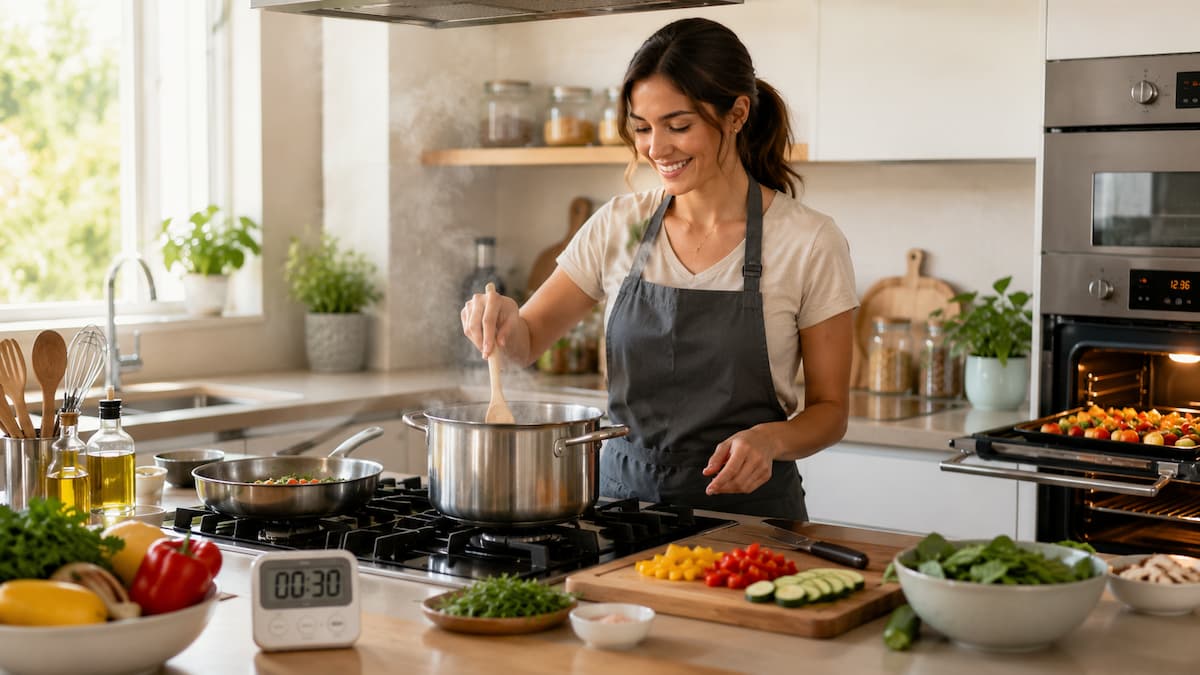
Cooking one dish is usually straightforward because there is only one timeline to think about. When several dishes need to reach the table at roughly the same time, however, cooking becomes a coordination problem. One pan may need attention while something is roasting in the oven, another component may need time to rest, and a salad or sauce may still be unfinished. Even when every individual recipe is familiar, putting everything together can make the kitchen feel unexpectedly chaotic.
The solution is not to cook faster. It is to stop treating every dish as if it has its own independent schedule. Instead, consider the entire meal as one sequence of tasks for a smoother approach. Some components can be prepared early, some can cook unattended, some need attention at the last minute, and others actually benefit from sitting for a few minutes before serving.
Once those differences become part of the plan, serving several dishes together becomes much more manageable.
Start With the Serving Time
The easiest way to lose control of a multi-dish meal is to begin cooking without deciding when the food needs to be ready.
Choose the approximate serving time first. It does not have to be exact to the minute, but you should have a target such as 7:00 p.m. or “about 20 minutes from now.”
Then work backward.
If a roast needs 15 minutes to rest, it cannot come out of the oven at the same moment you want to eat. If vegetables take 25 minutes to roast, their cooking needs to begin earlier. If a sauce takes only five minutes, there is little reason to prepare it an hour ahead.
The serving time becomes the anchor for everything else.
Think backward rather than forward
Instead of asking, “What should I start with?”
Ask:
“What needs to happen immediately before we eat?”
Then move backward through the meal.
For example:
| Component | Approximate action |
|---|---|
| Main dish | Finish and rest |
| Sauce | Finish while main rests |
| Vegetables | Finish shortly before serving |
| Grain or starch | Keep warm or finish earlier |
| Salad | Assemble near serving |
| Plating | Final few minutes |
The exact order will change with the meal, but working backward makes dependencies much easier to see.
Identify the Slowest Component First
Every meal usually has one or two components that control the schedule.
It could be a roast, baked casserole, rice dish, roasted vegetables, or another preparation that cannot simply be rushed at the end.
Find that component first.
Once its cooking time is understood, place it on the timeline. The faster components can then be fitted around it.
This is much easier than preparing dishes in the order they happen to appear on a recipe page.
Separate cooking time from total time
A recipe may say something takes 30 minutes, but that does not necessarily mean it requires 30 minutes of active attention.
For example, something might require:
- 10 minutes of preparation
- 20 minutes in the oven
- 5 minutes of resting
Those are three different types of time.
The oven period may give you an opportunity to prepare another component. Resting time may create an ideal window for making a sauce.
Understanding these distinctions creates opportunities to overlap tasks.
Divide Tasks Into Active and Passive Time
This is one of the most useful ideas when several dishes are being prepared.
Active time requires your attention. You may need to stir, flip, chop, whisk, season, or monitor the food closely.
Passive time is when food is cooking without constant intervention.
If something is simmering safely, roasting, baking, or resting, you may be able to use that period for another task.
The goal is not to make every minute busy. It is to use passive periods intelligently.
Trying to actively cook two things at once can be stressful. Preparing one component while another cooks unattended is often much easier.
Build a Simple Timeline Before You Start
You do not need a complicated spreadsheet.
A short written sequence can be enough.
For a meal with roasted chicken, vegetables, rice, and a sauce, your plan might roughly look like:
T−60: Start the longest cooking component.
T−40: Prepare vegetables and place them in the oven.
T−25: Start the rice.
T−15: Prepare sauce ingredients.
T−10: Begin finishing the sauce or another stovetop component.
T−5: Check seasoning and final temperatures.
T: Plate and serve.
The times are only an example. The important point is that each task has a place in relation to the final meal rather than being treated as an isolated recipe.
Don’t Give Every Dish the Same Deadline
Not everything needs to finish at the exact same second.
Some foods actually hold well for a short period. Others are best served immediately.
Understanding this difference makes timing much easier.
A roasted vegetable can often tolerate a few extra minutes. A sauce may be reheated or finished shortly before serving. A salad can often wait briefly once dressed, depending on the ingredients. Crispy foods, on the other hand, may lose their texture quickly.
Create a priority order
Think of the meal in three groups:
Finish early: Foods that hold reasonably well.
Finish close to serving: Foods that benefit from being warm and fresh.
Finish last: Foods whose texture or temperature changes quickly.
This prevents the common mistake of trying to finish everything simultaneously.
Use Resting Time as Part of the Schedule
Resting is often treated as dead time, but it can be extremely useful.
A cooked protein may need a few minutes before slicing. During that period, the pan or stovetop may become available for another component.
Instead of thinking, “The main dish is finished, so now I have to wait,” think:
“The main dish is resting, so I have a short finishing window.”
That window can be used to make a pan sauce, warm another component, finish vegetables, or prepare the serving area.
The food is doing something useful while you work on something else.
Coordinate the Oven Before You Turn It On
The oven can become the biggest bottleneck when several dishes require different temperatures.
Before starting, check which components need oven space and at what temperatures.
If two dishes require similar temperatures, they may be able to cook at the same time. If they require different temperatures, determine which item can be cooked earlier or later without affecting quality.
Also consider physical space.
A recipe may technically fit in the oven, but overcrowding can affect airflow and cooking results. When multiple trays are involved, placement can matter as much as timing.
Give the oven a sequence
Rather than thinking about each tray separately, create one oven timeline.
For example:
First: Long-cooking main dish.
Next: Add vegetables when enough oven time remains.
Later: Remove the main dish to rest while another component finishes.
This creates a chain instead of several competing schedules.
Don’t Forget the Stovetop
The same principle applies to burners.
A meal may involve boiling water, cooking a protein, reducing a sauce, warming vegetables, and preparing another component.
The problem is not necessarily the number of burners. It is failing to decide which pan needs which burner and when.
A burner occupied by something that is barely simmering may be needed later for a task requiring higher heat.
When planning the sequence, consider which tasks are dependent on the stovetop and which can be moved elsewhere.
Prepare Ingredients Before the Busy Stage
When several dishes are cooking, chopping vegetables or measuring spices at the same time can quickly become overwhelming.
Preparing ingredients before the most demanding cooking begins can remove that pressure.
This does not mean preparing every ingredient hours in advance. It means identifying the moments when your attention will be most limited and completing easy preparation before those moments arrive.
For example, if a sauce requires several measured ingredients while another pan needs constant attention, measure the sauce ingredients first.
That turns a complicated multitasking moment into a short finishing task.
Keep Similar Tasks Together
Efficiency often comes from grouping small jobs.
If several dishes require chopped onions, prepare them at the same time. If multiple components need herbs, wash and chop the herbs together. If several ingredients need measuring, organize them before cooking becomes busy.
This reduces repeated setup and cleanup.
It also makes it easier to remember what has already been prepared.
The key is to combine tasks that genuinely share ingredients or equipment without creating confusion between components.
Label or Separate Components When Necessary
When several dishes use similar ingredients, it is easy to forget which bowl belongs to which recipe.
This becomes especially relevant when preparing food in advance.
Simple labels, separate bowls, or placing ingredients in the order they will be used can help.
You do not need elaborate containers for every meal. The purpose is simply to prevent the mental work of repeatedly asking, “Was this for the sauce or the vegetables?”
A clear arrangement can be as useful as a written schedule.
Use Timers as Reminders, Not as Your Entire System
Timers are extremely useful when several things are happening at once.
But setting six timers without a larger plan can create another kind of chaos.
A timer should answer a specific question:
What needs my attention at this moment?
If something needs to be checked after 15 minutes, set a timer. If something only needs attention near the end, a timer can protect you from forgetting it.
For dishes with several stages, however, it is often better to understand the entire sequence rather than relying on isolated alarms.
Allow for the Unexpected
Cooking times are estimates.
A thick piece of food may take longer than expected. A pan may not heat as quickly as anticipated. Vegetables may need additional time. The oven may already be occupied.
This is why a good timeline should contain some flexibility.
Do not schedule every component so tightly that a five-minute delay ruins the entire meal.
Where possible, finish components with some buffer before serving time. Keep the most time-sensitive tasks toward the end and leave yourself room to adjust.
Know Which Foods Can Wait
Timing becomes much easier when you understand how food behaves after cooking.
Some dishes improve or remain perfectly acceptable after a short holding period. Others lose crispness, freshness, or texture quickly.
A casserole, roasted vegetables, or certain braised foods may tolerate waiting better than delicate fried foods.
A useful meal plan therefore considers not only when something finishes, but how it behaves after finishing.
This can change the order in which you cook.
Use Warm Holding Carefully
Some foods can be kept warm for a short period, but “keep warm” should not become an excuse to leave food sitting indefinitely.
The quality of many foods deteriorates when held too long. Rice, vegetables, sauces, proteins, and fried foods can all change in texture depending on how they are handled.
For a home meal, it is generally better to plan for a short, controlled holding period than to finish everything an hour before eating.
The closer the food is to its ideal serving condition, the less you have to compensate for holding.
Plan the Final Five Minutes
The last few minutes are where many multi-dish meals become stressful.
This is when food is finished, pans are still on the stove, serving dishes need to be found, and someone may already be asking when dinner is ready.
Make this period as simple as possible.
Before it arrives, know where the plates or serving dishes are going, which foods need final seasoning, which components need slicing, and what can be moved off the heat.
The final five minutes should be about finishing rather than discovering what still needs to be done.
Finish Seasoning at the Right Time
Not every dish should receive its final seasoning at the beginning.
Some foods change as they cook. Liquid evaporates, flavors concentrate, sauces reduce, and ingredients release water.
For that reason, final tasting and adjustment often belongs near the end.
This is especially important when several dishes are being prepared simultaneously. You may have seasoned a component earlier, but its final balance may not be clear until cooking is complete.
Build a short tasting and finishing period into the schedule rather than treating seasoning as an afterthought.
Use One Dish to Support Another
Multiple dishes become easier to coordinate when one component can contribute to another.
Pan drippings can become a sauce. Roasted vegetables can provide a component for another dish. Cooking liquid may support a sauce or grain. A prepared ingredient can appear in more than one part of the meal.
This is not only efficient; it can also make the meal feel more connected.
Instead of managing five completely separate recipes, you begin to see a meal as a collection of components that interact.
What to Do When One Dish Finishes Too Early
This happens frequently.
If something finishes ahead of schedule, do not immediately assume the meal is ruined.
First determine whether it can rest, remain warm briefly, or be finished later.
For some foods, removing them from direct heat prevents overcooking. For others, a brief rest improves the final result.
The correct response depends on the food, but the general principle is the same: stop cooking when necessary rather than continuing simply because the rest of the meal is not ready.
Overcooking one component to make the timing match another is rarely a good solution.
What to Do When Something Is Running Late
When one component falls behind, resist the urge to make every other dish wait.
Look at what can still move forward.
Maybe the vegetables are already finished. Perhaps the sauce can be completed. The table can be set. A resting component can be sliced later.
Then decide whether the delayed food can be accelerated safely.
Increasing heat is not automatically the answer. Some foods can tolerate a faster cooking process; others may burn on the outside before the center is ready.
The best recovery strategy is usually to adjust the sequence rather than simply cooking everything harder.
A Multi-Dish Meal Is a Sequence, Not a Race
Cooking several dishes at once can feel difficult because attention is divided. But the answer is not necessarily greater speed.
The real skill is sequencing.
Know which component controls the timeline. Identify what can happen while something else cooks. Prepare ingredients before the busiest stage. Give resting foods a useful place in the schedule. Leave a little flexibility for delays, and reserve the final minutes for finishing rather than major preparation.
Once you start thinking in these terms, a multi-dish meal becomes less like several recipes competing for attention and more like one coordinated process.
A Practical Example of the Approach
Imagine you are preparing a meal containing roasted chicken, potatoes, green vegetables, and a pan sauce.
The chicken is the slowest component, so it establishes the initial timeline. While it cooks, the potatoes can be prepared and added according to their required cooking time.
The green vegetables can be left until later because they need much less time. When the chicken comes out to rest, its pan can become the starting point for the sauce.
Now the resting period is useful rather than inconvenient.
The final minutes can be used to finish the vegetables, adjust the sauce, slice the chicken, and bring everything together.
Nothing required every component to finish simultaneously. Each component simply had to finish at the right point in the overall sequence.
Build Your Own Timing Habit
You do not need to create a written timeline for every ordinary dinner.
With practice, the process becomes mental.
You begin recognizing that rice needs to start before the vegetables, that a roast needs resting time, that a sauce can be made while something else rests, and that delicate vegetables should not be cooked too early.
That experience gradually reduces the amount of conscious planning required.
For complicated meals, a quick written timeline is still useful. For familiar meals, the same principles can operate almost automatically.
The Goal Is a Calm Finish
A well-timed meal does not necessarily mean every dish reaches the table at exactly the same second.
It means the important components arrive in good condition without forcing you to rush through the final stages.
Some food may rest. Some may finish slightly earlier. A sauce may be made at the last minute. A vegetable may need an extra few minutes.
That is normal cooking.
The real improvement comes when you know what can wait, what cannot, and what task should happen next. Once the sequence is clear, the kitchen becomes much easier to manage—even when several dishes are cooking at once.
Frequently Asked Questions
How do I time several dishes to finish together?
Start by choosing the desired serving time and then work backward from it. Identify the longest-cooking component first, followed by foods that require less time. Account for preparation, cooking, resting, and final seasoning separately. Components that hold well can finish earlier, while delicate foods should be scheduled closer to serving.
What should I cook first when making several dishes?
Usually, begin with the component that takes the longest or has the least flexibility in its cooking time. Once it is underway, use its cooking or resting periods to prepare components that require more attention. This prevents the slowest dish from becoming the final bottleneck.
How can I avoid having everything need my attention at once?
Separate active and passive cooking tasks. Start foods that can cook unattended before beginning tasks that require constant stirring, flipping, or monitoring. Prepare ingredients in advance and use resting or oven time to complete other components.
Should all dishes finish at the same time?
No. Some foods can rest or hold briefly without a major loss in quality, while others are best served immediately. The goal is to understand which foods need to be finished last and which can safely be completed earlier.
What should I do if one dish is running late?
First determine whether the delayed food can safely be finished faster. Then look for other components that can continue without waiting. Avoid overcooking finished dishes simply to make them synchronize with the delayed one. Adjusting the sequence is usually better than rushing every component.
Is it better to prepare everything before starting to cook?
Not necessarily. Preparing every ingredient in advance can create unnecessary work. A better approach is to prepare the ingredients needed during the busiest parts of cooking before those moments arrive. This gives you the benefits of preparation without turning every meal into a large mise-en-place project.