
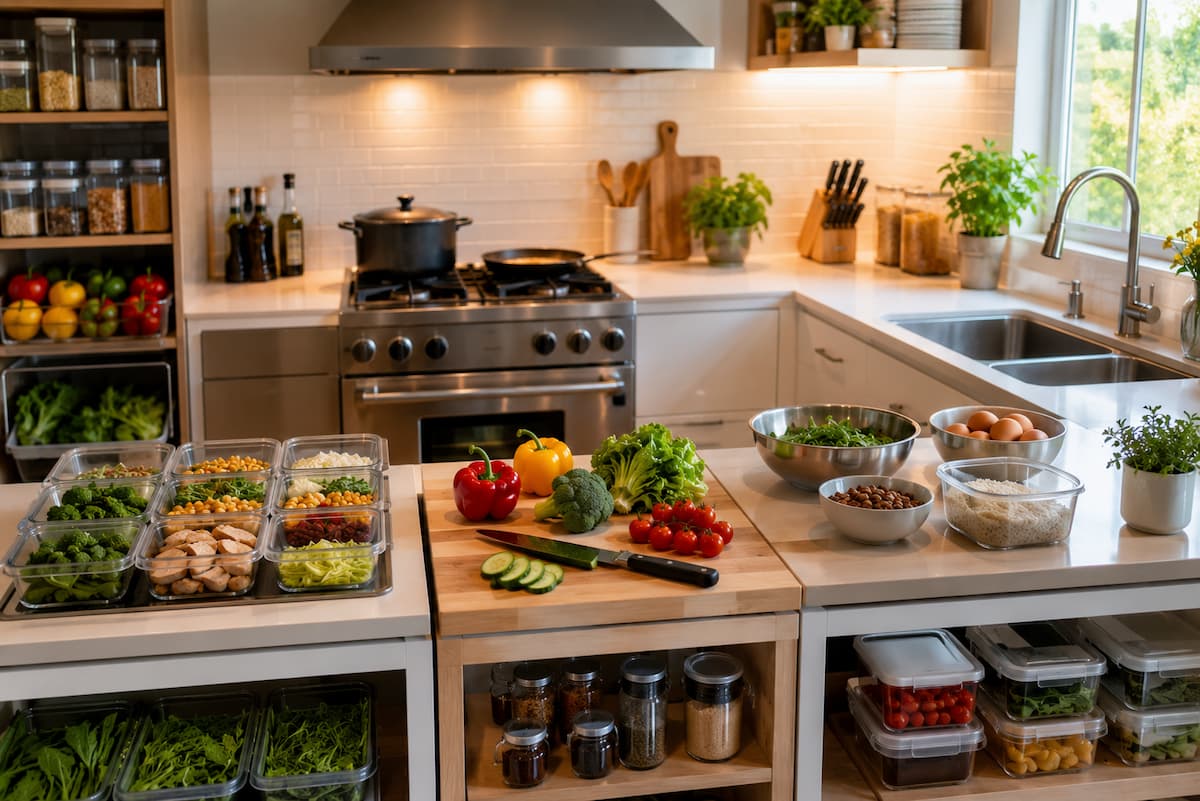
Cooking zones offer a practical way to organize around the work itself rather than simply arranging items by category. Instead of asking where every kitchen item technically belongs, you look at what happens during cooking and place the things used together within sensible reach of one another. The result does not need to look like a professional kitchen. Even a small adjustment to where you position tools, ingredients, and work surfaces can make daily cooking smoother.
The goal is not to create more rules. It is to remove small obstacles from the path between deciding to cook and getting the meal onto the table.
Start With the Tasks, Not the Cabinets
The easiest mistake when organizing a kitchen is starting with storage. You open a cabinet, decide what should go inside it, and rearrange everything according to appearance. That may make a cupboard look tidy without making cooking any easier.
Instead, begin by thinking about the sequence of ordinary meals. Ingredients come out of storage, food gets washed or prepared, ingredients are cut, cookware is heated, food moves to the stove or oven, and finished dishes eventually reach a serving or cleaning area.
The exact sequence varies, but the principle is the same: items that repeatedly work together should not be unnecessarily separated.
Watch your own movements
Before moving anything, pay attention to one normal cooking session.
Notice how often you walk to another part of the kitchen for a utensil, open several drawers looking for something, turn around to reach an ingredient, or carry prepared food across the room to reach the stove.
These observations are more useful than generic kitchen-organization advice because they reveal the specific friction points in your own space.
You may discover that the biggest problem is not lack of storage at all. It might be that your cutting board has no comfortable place near the refrigerator, or that your most frequently used spatula is stored in a drawer behind you.
The Main Zones Most Kitchens Need
You do not need a complicated professional-style kitchen map. Most home kitchens can benefit from thinking in terms of a few broad work areas.
A practical setup can include:
| Zone | Main purpose | Useful items nearby |
|---|---|---|
| Prep zone | Cutting, peeling, measuring | Knives, boards, bowls, measuring tools |
| Cooking zone | Stovetop and active cooking | Pans, spatulas, tongs, oils, seasonings |
| Baking or oven zone | Oven-based cooking | Oven mitts, trays, baking tools |
| Serving zone | Plating and finishing | Plates, serving utensils, trivets |
| Cleaning zone | Washing and cleanup | Dish soap, towels, brushes, waste bin |
These zones do not have to occupy separate sections of the kitchen. In a small kitchen, several may overlap.
The purpose is simply to identify what each area is responsible for and place frequently used items where they support that work.
Make the Prep Zone Your Main Work Surface
For many meals, preparation is where the largest number of small tasks happen. Vegetables are trimmed, ingredients are measured, meat is portioned, herbs are chopped, and prepared ingredients are placed into bowls.
A good prep zone therefore deserves more attention than simply finding somewhere to put a cutting board.
Ideally, it should have a stable work surface with enough room to separate ingredients that are ready to cook from ingredients that have not yet been prepared.
Keep the basic prep tools together
The exact collection depends on how you cook, but commonly used prep tools might include:
- One or two dependable knives
- A cutting board
- Mixing or prep bowls
- Measuring spoons
- Measuring cups
- Vegetable peeler
- Kitchen shears
Not every tool needs to live permanently on the counter. The useful principle is that the tools used repeatedly during preparation should be easy to retrieve without opening several unrelated cabinets.
If you use a particular knife, board, and bowl for most daily cooking, their location should reflect that frequency.
Build the Cooking Zone Around the Stove
The cooking zone is where unnecessary movement can become particularly frustrating. Once a pan is hot and food is actively cooking, you do not want to leave the stove repeatedly to find a utensil or seasoning.
Keep the tools used during active cooking reasonably close to the stovetop.
Tongs, spatulas, wooden spoons, ladles, and frequently used cooking utensils are obvious examples. Cooking fats and everyday seasonings may also belong nearby if the available storage allows it and the area remains safe and uncluttered.
The key word is frequently. A tool used once every few months does not need prime real estate beside the stove.
Don’t overcrowd the cooking area
There is a point at which convenience becomes clutter.
If every utensil, spice jar, bottle, and appliance is permanently sitting beside the stove, the cooking zone can become harder to use. Counter space disappears, cleaning becomes more difficult, and ingredients can end up in places where they are exposed to unnecessary heat or splashes.
Keep the items that genuinely support active cooking close. Store the rest elsewhere.
Place Tools According to Frequency
One of the simplest improvements you can make is to stop treating every kitchen item as equally important.
The tool you use every day should be easier to reach than the tool you use twice a year.
A useful system has three broad levels:
Daily-use items should be immediately accessible.
Regular-use items can be stored nearby but do not need to occupy the easiest locations.
Occasional items can live in higher cabinets, deeper drawers, or less convenient storage.
This approach creates a kitchen that works according to actual behavior rather than the number of objects you own.
Think About the Path From Refrigerator to Prep Surface
The refrigerator is one of the most frequently visited parts of a kitchen. Ingredients often move from the refrigerator to the work surface before they go anywhere else.
If your layout permits it, keeping a useful preparation area reasonably close to the refrigerator can reduce repeated carrying.
You do not need to redesign the room to achieve this. Even something as simple as keeping your primary cutting board near the refrigerator or storing frequently used prep bowls in the nearby cabinet can reduce unnecessary movement.
The important thing is to observe the path you already take and identify where it becomes awkward.
Create a Small Pantry or Ingredient Zone
Frequently used dry ingredients can also benefit from a dedicated area.
Salt, pepper, cooking oils, grains, pasta, canned ingredients, spices, and other staples often appear in many different meals. If they are scattered across several cabinets, every cooking session involves additional searching.
A practical ingredient zone does not mean putting everything together. Some foods need appropriate storage conditions, and certain items should remain away from heat, moisture, or direct sunlight.
Instead, group ingredients according to how often and how commonly they are used.
Keep everyday staples easy to reach while leaving specialized ingredients in less prominent storage.
Don’t Forget the Transfer Zone
One area that is often overlooked is the space between preparation and cooking.
You may chop vegetables at one location, then need somewhere to place them while preparing the next ingredient. Without a convenient landing area, bowls end up balanced on appliances or crowded around the cutting board.
A small amount of clear counter space can solve this.
You do not necessarily need another piece of furniture. Sometimes the most valuable improvement is simply keeping one section of counter intentionally clear so prepared ingredients have somewhere to wait.
That empty space is functional storage of a different kind: it provides room for the cooking process itself.
Make the Oven Zone Easy to Use
If you regularly bake, roast, or use sheet pans, think about what happens immediately before and after food enters the oven.
Oven mitts should be accessible without requiring you to walk across the kitchen while carrying a hot dish. Baking sheets and roasting pans should not be buried beneath unrelated equipment if they are used regularly.
A heat-safe surface or designated place for hot cookware can also prevent the need to search for somewhere to set a pan down.
This is especially useful when several components are being cooked at the same time.
Keep Serving Supplies Near the Point of Use
Serving does not need its own room or cabinet, but it deserves some consideration.
If plates, bowls, serving spoons, and common tableware are stored close to where finished food is transferred from the stove or counter, the final stage of meal preparation becomes simpler.
For households that serve food directly at the table, it may make more sense to keep everyday dishes closer to the dining area. The correct arrangement depends on the actual flow of your home.
The principle remains the same: store frequently used items according to how they move through the kitchen.
Use the Vertical Space You Already Have
Small kitchens often run out of convenient counter and drawer space before they run out of wall space.
Where appropriate, vertical storage can keep frequently used items accessible without consuming the main work surface. Shelves, rails, hooks, or cabinet organizers can sometimes help, provided they are installed safely and do not interfere with cooking.
However, vertical storage should solve a specific problem rather than become another opportunity to display every kitchen item.
If a wall-mounted rack makes one frequently used tool easier to reach, it has a purpose. If it simply adds visual clutter, it may not improve the workflow.
Small Kitchens Need Fewer Zones, Not More
The word “zones” can make kitchen organization sound complicated, especially in a limited space.
A small kitchen may effectively have only two major areas: a prep-and-storage zone and a cooking-and-serving zone. That is completely fine.
The zones are conceptual. They do not require separate counters.
In a compact kitchen, the same counter may serve as a preparation surface before becoming a serving area. A drawer beside the stove may hold both cooking utensils and a few prep tools because there simply is not enough space for separate storage.
The objective is not to reproduce a large professional kitchen. It is to make the available space work with fewer unnecessary movements.
Don’t Store Everything Where It “Looks Best”
A common organizing instinct is to arrange items according to visual neatness.
That can be useful, but function should come first.
A perfectly organized drawer is not particularly helpful if the item you need every evening is buried at the back. Similarly, an attractive countertop arrangement can make cooking slower if it removes the workspace you actually need.
Organize around frequency, sequence, and convenience first. Once the system works, you can improve its appearance.
Test One Zone Before Reorganizing the Entire Kitchen
You do not need to empty every cabinet to improve your cooking workflow.
Choose the area that causes the most frustration. If you constantly struggle to prepare ingredients, start with the prep zone. If active cooking requires repeated trips around the room, start near the stove.
Move only the items that support that particular task.
Then cook normally for several days.
If the arrangement makes cooking easier, keep it. If something feels awkward, change it. This gradual approach is often more successful than attempting a complete kitchen transformation in one afternoon.
A useful before-and-after test
Ask yourself:
- Am I reaching less often?
- Is my main work surface easier to use?
- Can I find frequently used tools quickly?
- Are prepared ingredients easier to manage?
- Does cleanup remain practical?
- Did the change create a new problem somewhere else?
The last question matters. Moving a tool closer to the stove may make cooking easier but make a drawer difficult to access. Good organization improves the overall workflow rather than optimizing one tiny section at the expense of another.
Keep Safety Outside the Convenience Equation
Kitchen organization should never place convenience above safe cooking.
Keep handles, hot surfaces, and electrical cords arranged so they are not creating unnecessary hazards. Avoid storing ingredients or equipment where heat, steam, grease, or water can damage them.
Heavy objects should be stored securely, and frequently used sharp tools should have a storage method that protects both the user and the blade.
A cooking zone is successful only when it makes the kitchen easier to use without making it less safe.
The Cleanup Zone Should Support the Entire Workflow
The kitchen does not stop functioning when the meal goes onto the plate.
During preparation, scraps accumulate. Bowls and utensils become dirty. Cutting boards need to be moved out of the way. Pans eventually need cleaning.
Keeping waste disposal, towels, dishwashing supplies, and other cleanup essentials reasonably accessible can prevent the final stage from becoming another series of unnecessary trips.
You can also use the workflow itself to reduce mess. Keep a small scrap bowl nearby while chopping, return ingredients to storage as soon as they are no longer needed, and clean small items during moments when food is simmering or roasting.
The objective is not to clean constantly. It is to prevent the workspace from becoming progressively harder to use.
A Cooking Zone Should Change With Your Habits
Your kitchen does not need to remain organized the same way forever.
If you start cooking more frequently, a tool that was once occasional may become a daily item. If you stop baking regularly, baking equipment may no longer deserve prime storage space.
This is why kitchen organization should be treated as an adjustable system rather than a permanent arrangement.
Every few months, notice what you actually reach for. Items that are constantly being moved around may be stored in the wrong place. Items that you haven’t touched for months may be taking up valuable space.
The kitchen should reflect the way you cook now.
When You Have to Choose Between Storage and Workspace
More storage is not always the answer.
In many kitchens, adding another appliance, container, rack, or organizer can reduce the amount of usable counter space. That can make cooking slower even though the kitchen technically holds more things.
A clear work surface has value.
If you frequently chop, mix, assemble, or plate food, protecting enough open space for those tasks may be more useful than finding a home for another collection of equipment.
Before buying an organizer, ask whether the problem is genuinely a lack of storage or simply too many items occupying the most useful areas.
Build the Kitchen Around Movement, Not Perfection
A well-organized cooking space does not have to look like a showroom.
The real test is what happens when you cook.
Can you get an ingredient from storage to the prep surface without unnecessary backtracking? Can you reach the tool you need while food is cooking? Is there somewhere to place a hot pan? Can prepared ingredients wait without taking over the entire counter? Can you clean up without repeatedly crossing the kitchen?
If the answers are mostly yes, the system is doing its job.
Cooking zones are ultimately about reducing friction. They turn the kitchen from a collection of cabinets and appliances into a workspace with a sensible flow.
Make Small Changes That Save Repeated Effort
You do not need a renovation to create a faster kitchen.
You can reduce unnecessary movements by moving the cutting board closer to your most used ingredients, keeping everyday utensils near the stove, creating a clear landing area for prepared food, and giving frequently used pantry staples a consistent home.
One change may save only seconds. But when the same movement happens during hundreds of meals, those small improvements add up.
More importantly, a kitchen that supports the way you naturally cook makes the process feel less interrupted. You spend more time actually preparing food and less time searching, reaching, carrying, and rearranging.
Frequently Asked Questions
Where should I keep cooking utensils?
Frequently used utensils such as spatulas, tongs, and wooden spoons should be stored close enough to the cooking area that you can retrieve them without leaving active cooking unattended. The exact location depends on your kitchen layout. Avoid placing so many tools around the stove that they create clutter or interfere with cleaning.
Should spices be kept next to the stove?
Frequently used seasonings can be convenient near the cooking area, but they should not be stored where heat, steam, or grease can unnecessarily affect them. A nearby cabinet or drawer may be a better option than an exposed rack directly beside a hot burner. Convenience should be balanced with appropriate storage conditions.
How can I speed up meal preparation without remodeling my kitchen?
Start by changing the placement of items rather than the kitchen itself. Keep your main cutting board and knives near your most useful prep surface, move everyday cooking utensils closer to the stove, create a clear area for prepared ingredients, and organize frequently used pantry items so they are easy to find. Test one change at a time before buying new storage equipment.
How often should I reorganize my kitchen zones?
There is no fixed schedule. Review the arrangement whenever your cooking habits change or when you repeatedly notice the same inconvenience. If certain tools are constantly being moved to another location before use, that is a good indication that your current organization may not match your actual workflow.