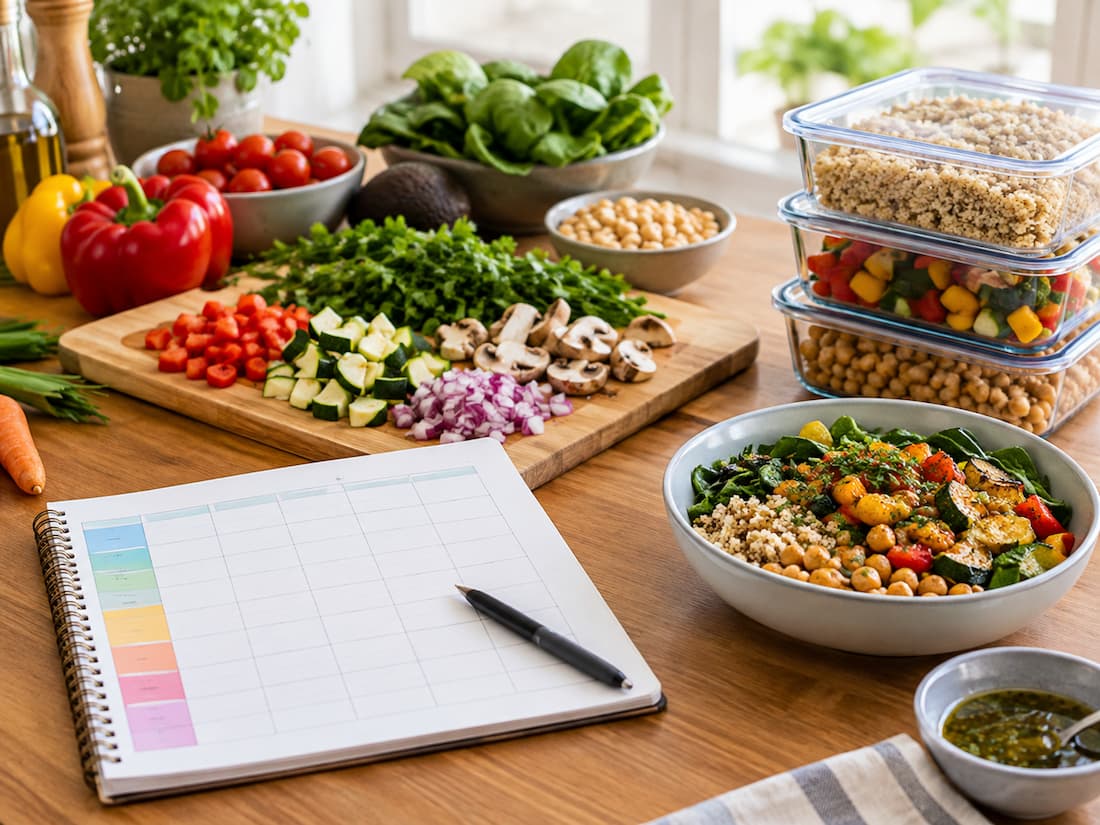
Planning several meals for the week becomes much easier when you stop treating every dinner as a completely separate cooking project. Instead of choosing seven unrelated recipes and preparing every ingredient from scratch, look for ingredients that can share part of the same preparation. A batch of chopped onions might serve a soup, a rice dish, and a skillet meal. A tray of roasted vegetables can become a side dish one night, a filling for wraps another night, and an addition to eggs or grains later in the week. The goal is not to eat the same meal repeatedly. It is to prepare certain ingredients once and use them in different ways. This approach can reduce repeated chopping, washing, measuring, and setup while still leaving room for meals that feel different. It also changes the way you make a grocery list: instead of thinking only in terms of finished dishes, you begin looking for useful connections between them.
Start With Shared Preparation, Not Identical Meals
The most useful connection between two meals is not necessarily that they contain the same finished ingredients. What matters is whether they can share a meaningful preparation step.
For example, imagine these three meals:
- Chicken and vegetable rice
- Vegetable soup
- Chicken wraps
They could share some preparation without becoming three versions of the same meal. Onions, carrots, and bell peppers might be washed and cut during one preparation session. Chicken could be prepared in a form that works for both the rice dish and wraps, while the soup uses the vegetables separately. The meals remain distinct because the ingredients are combined, seasoned, and cooked differently. This distinction is important. A well-designed shared-prep plan creates ingredient connections, not a week of identical leftovers.
A useful question when planning is:
“What preparation can these meals have in common?”
rather than:
“How many meals can I make from exactly the same cooked food?”
The first question leads to flexibility. The second can quickly lead to repetitive meals.
Look for Ingredients With Multiple Jobs
Some ingredients naturally fit into several types of meals. These are especially useful when building a weekly plan.
Common examples include:
- onions
- garlic
- carrots
- bell peppers
- leafy greens
- cooked grains
- potatoes
- roasted vegetables
- beans
- cooked chicken
- tomato-based mixtures
- fresh herbs
- simple sauces or dressings
However, an ingredient does not have to appear in every meal to be useful. If one preparation helps with two or three meals, that may be enough to justify doing it in advance. Consider onions. You might chop enough for a soup, a stir-fry, and a savoury rice dish. The important part is not that all three meals taste the same. It is that one chopping session can support several separate cooking processes. The same principle works with vegetables. A batch of roasted carrots and peppers can be used as a side dish, mixed with grains, or added to a wrap. Their final role changes even though the initial preparation overlaps.
Build a Prep Map Before Making the Grocery List
A simple prep map can reveal useful connections that are easy to miss when you only look at recipes individually. Start by writing down four or five meals you might actually eat during the week. They do not need to cover every meal for every day of the week. The purpose is to identify repeated preparation. For each meal, note the ingredients that require work.
For example:
| Meal | Shared preparation |
|---|---|
| Chicken rice bowl | Chopped vegetables, cooked chicken, cooked rice |
| Vegetable soup | Chopped vegetables |
| Chicken wraps | Cooked chicken, chopped vegetables |
| Fried rice | Cooked rice, chopped vegetables |
| Grain salad | Cooked grain, chopped vegetables, herbs |
The overlap becomes much clearer when viewed together.
You might discover that preparing vegetables once could support four meals, while cooking a larger amount of rice could support two. That gives you a practical starting point for the week without needing to plan every meal in detail. The prep map is also useful for spotting false efficiency. If one ingredient appears in several recipes but requires entirely different preparation each time, it may not actually save much work.
Separate Shared Prep From Shared Cooking
This is one of the most useful distinctions in this planning method.
- Shared prep means an ingredient receives the same early preparation but is later used differently.
- Shared cooking means a larger quantity of food is cooked together and then divided among meals.
They are not interchangeable. Suppose you wash and chop bell peppers for three meals. That is shared preparation. You can later sauté some, roast some, and add some raw to another dish. If you roast all the peppers at once and divide them between meals, that is shared cooking.
Shared prep generally gives you more flexibility because you have not committed the ingredient to one cooking method. Once a vegetable has been roasted, for example, its texture and flavour have already changed. You can still use it in different dishes, but your options are narrower. For a flexible week, prepare ingredients in ways that leave several possible uses open.
Choose Preparations That Survive Different Meals
Not every preparation is equally useful across a week. A neutral or lightly seasoned ingredient usually has more possible uses than one with a strong, specific flavour.
For example, simply cooked rice can become:
- a base for a bowl
- fried rice
- an accompaniment to a saucy dish
- part of a grain-and-vegetable meal
But rice heavily seasoned for one particular dish may be harder to adapt. The same applies to proteins and vegetables. If you know one meal needs strongly seasoned chicken and another needs a mild filling, cooking the entire batch with the strongest seasoning can limit your options.
A better approach is sometimes to prepare the basic ingredient first and add the final flavour during the meal’s actual cooking. This does not mean everything needs to be bland. It means that early preparation should not unnecessarily eliminate later choices.
Think in Preparation for Families
Instead of planning seven completely separate meals, group meals according to the work they require.
For example, you might have a vegetable-preparation family:
- soup
- stir-fry
- vegetable omelette
- grain bowl
And a cooked-grain family:
- rice bowl
- fried rice
- grain salad
And a protein family:
- chicken wraps
- chicken rice
- chicken and vegetables
These groups can overlap. That is actually useful. The aim is not to create rigid categories. It is to see where one preparation session can serve several meals.
A week might therefore look like this:
Preparation session:
Wash and cut vegetables, cook a grain, prepare a basic protein, and wash herbs.
Meal 1:
Use the vegetables with the protein and grain.
Meal 2:
Use some of the vegetables in the soup.
Meal 3:
Turn the grain and vegetables into a different skillet meal.
Meal 4:
Use the protein and fresh vegetables in wraps.
The meals have a common foundation but do not have to look or taste identical.
Do Not Prep Everything on the Same Day
Shared preparation can save work, but preparing every ingredient at once can create unnecessary storage problems. Some ingredients are better prepared close to when they will be used. Others are convenient to prepare earlier. A practical plan is to divide preparation into levels.
Prepare Early
These are ingredients that may be useful in several meals and whose preparation is relatively straightforward.
Examples can include:
- washing sturdy vegetables
- chopping onions for several meals
- cooking grains intended for planned meals
- preparing certain cooked proteins
- washing and drying herbs when appropriate
Prepare Closer to Cooking
Some foods are better left closer to their final use because cutting or cooking them early can affect their quality.
Examples may include:
- delicate herbs
- ingredients that brown quickly after cutting
- vegetables whose texture is especially important when fresh
- components that are intended to stay crisp
This is where shared prep should remain flexible. The objective is not to perform every possible task on Sunday simply because you are planning a week of meals.
Design Around Your Actual Kitchen Work
A meal plan can look efficient on paper while creating a frustrating amount of work in the kitchen. Suppose three meals all require roasted vegetables. Cooking them together might seem obvious, but it depends on whether your oven tray has enough room and whether the vegetables can cook properly without being crowded. Likewise, several meals may call for separate pans or pots at the same time. Even when you plan the ingredients well, your cookware can still become the bottleneck. If your weekly preparation repeatedly involves choosing which dish gets the available pan or pot first, the plan needs to account for that physical limitation. The Pan & Pot Space Planner can be useful when a shared-prep plan involves several cookware requirements and you want to think through the available pan and pot space before cooking. The point is simple: efficient meal planning includes kitchen capacity, not just ingredients.
Use One Preparation in Different Directions
- The strongest shared-prep plans create variety by changing the final combination.
- Imagine you have prepared cooked chicken, roasted vegetables, and cooked rice.
- One meal might combine them with a sauce and serve them in a bowl.
- Another might use the chicken and vegetables in a wrap.
- The rice could later be combined with different ingredients in a skillet meal.
- The preparation overlaps, but the finished meals are separated by texture, seasoning, format, and supporting ingredients.
- This is more satisfying than eating the same container of food three nights in a row.
- It also gives you a way to respond to what you feel like eating. If you planned a bowl but would rather have a wrap, some of the same prepared ingredients may still work.
Avoid Creating an “Everything Goes Everywhere” Plan
There is a point where shared ingredients stop being helpful. If every ingredient is intended for five different meals, your plan can become complicated rather than efficient. You may end up tracking small portions, containers, and possible combinations instead of simply cooking.
A good shared-prep ingredient usually meets at least one of these conditions:
- It appears in several planned meals
- It requires noticeable preparation
- It keeps its usefulness after preparation
- It can be combined with different flavours
- Preparing it in advance removes a repeated task
If an ingredient takes thirty seconds to prepare and appears once, there may be little reason to build your entire weekly plan around it. The biggest savings often come from repeated tasks such as washing, chopping, cooking a basic component, or cleaning equipment used for several preparations.
Leave Some Ingredients Uncommitted
A useful weekly plan should have room for change. Suppose you prepare vegetables and grains but leave sauces, herbs, toppings, and some fresh ingredients for later. You can change the character of a meal without starting from scratch. One day the same basic ingredients might become a warm bowl. Another day they could become a salad or wrap.
Leaving some components uncommitted also helps when your schedule changes. If you planned a particular meal for Wednesday but do not have time to cook it, the prepared ingredients may still fit Thursday’s dish. This approach is different from having no plan. You have prepared a foundation while leaving the final combination open.
Plan Ingredients by Their Preparation Cost
When comparing two possible meal combinations, consider how much work the shared ingredients require. For example, three meals that all require chopped vegetables may save more repeated effort than three meals that happen to use the same spice. This is because chopping involves a physical task that can be repeated. A spice can simply be measured when needed.
You can consider preparation cost in simple terms:
1. High repeated effort:
washing, peeling, chopping, cooking, cooling, cleaning cookware
2. Moderate effort:
measuring several ingredients, mixing a dressing, portioning components
3. Low effort:
adding a dry spice, opening a prepared ingredient, sprinkling a topping
This does not require precise calculations. It is simply a way to notice where your weekly cooking time is actually going.
Give Ingredients Different Final Roles
Variety comes from more than changing recipes. The same prepared ingredient can feel different depending on what surrounds it.
Cooked carrots could be:
- a side dish with a main meal
- mixed into grains
- folded into an omelette
- combined with greens
- added to a soup
The ingredient’s role changes even though the initial preparation was shared. This is particularly useful for vegetables and grains because they can often move between different meal formats. Protein can also change role. Cooked chicken might become the central component of one meal and a smaller addition to another. The important part is to avoid assuming that every meal needs the same proportion of every prepared ingredient.
Use Fresh Finishing Ingredients to Create Contrast
Shared preparation works particularly well when the final meal includes something prepared separately.
For example, a prepared grain and cooked vegetable mixture can feel different when finished with:
- fresh herbs
- a different sauce
- a crunchy topping
- freshly cut vegetables
- a new seasoning combination
The finishing ingredient does not have to be complicated. Its purpose is to give the meal a different final character. This principle is also why it can be useful not to cook every component in advance. Some foods are valuable precisely because they provide freshness, crunch, or a different texture at the moment of serving.
Plan the Week From More Flexible Ingredients to More Specific Ones
Another useful strategy is to think about which prepared foods have the most possible future uses. A neutral cooked grain may work in several meals. A strongly flavoured finished dish may have only one clear role. If your schedule is uncertain, use flexible ingredients earlier in your planning and reserve more specific preparations for meals you are confident you will make.
For example, you might prepare a basic grain and vegetables while deciding later whether they will become a bowl, side dish, or skillet meal. This gives the plan some resilience without requiring you to prepare several complete meals.
Keep Food Safety Separate From Meal-Planning Efficiency
Sharing preparation does not mean ignoring safe food handling. Cooked foods and other perishable ingredients need appropriate handling, storage, and reheating based on food-safety guidance. The fact that an ingredient is intended for several meals does not automatically make it suitable to keep indefinitely.
When planning, consider the sequence in which foods will actually be used. If a prepared ingredient is intended for later in the week, make sure your storage plan is appropriate rather than assuming that everything prepared at the beginning of the week will remain safe and good quality until the end. There is also an important difference between quality and safety. An ingredient can lose texture or freshness before it becomes a food-safety concern, while another food may require careful handling even if it still looks and smells normal.
When in doubt about the storage or handling of a particular perishable food, use current guidance from a reliable food-safety authority rather than guessing.
A Simple Weekly Planning Method
You do not need a complicated spreadsheet to use this system.
Try this sequence:
1. Choose several meals you genuinely want to eat.
Start with realistic meals rather than designing the week around ingredients you think you should use.
2. List the repeated preparation tasks.
Look for chopping, washing, cooking grains, preparing proteins, and other tasks that occur more than once.
3. Mark the ingredients that can share preparation.
These become your core prep ingredients.
4. Decide what should remain fresh or uncommitted.
Do not prepare something early just because you can.
5. Check your cookware and storage capacity.
Make sure the plan fits the equipment and storage space you actually have.
6. Change the final role of shared ingredients.
Use different sauces, formats, textures, or supporting ingredients to keep meals distinct.
7. Leave room for one or two changes.
A flexible plan is easier to maintain than one where every meal has to happen on a specific day.
If you want recurring weekly variety without rebuilding this process from scratch every time, the Weekly Meal Rotation Builder can serve as an optional planning aid for organising meals across a week while keeping the rotation from becoming repetitive.
When Shared Prep Is Not Worth It
There are situations where separate preparation is perfectly reasonable. If two meals have almost no meaningful overlap, forcing them together may create more planning work than it saves. The same is true when an ingredient does not hold its intended quality after advance preparation, when storage space is limited, or when your schedule is unpredictable enough that prepared food is likely to sit unused. There is also a personal preference factor. Some cooks enjoy deciding what to make each day and may find extensive advance preparation restrictive. The technique should reduce friction, not turn cooking into another chore. Shared prep works best when it matches your actual habits.
The Main Idea: Share the Work, Not Necessarily the Meal
The most effective weekly meal plans do not require every dish to come from the same batch of food. Instead, they identify the small pieces of work that can be combined. Wash several vegetables during one session. Chop ingredients that appear in multiple meals. Prepare a basic grain that has several possible uses. Cook a component that can move between different meal formats. Then finish each meal differently. That approach gives you the practical advantage of advance preparation without making the entire week taste predetermined.
If several cooking decisions become complicated at once—especially when your plan involves different preparation tasks, cookware, and serving times—the Multi-Dish Cooking Timeline Planner can also help you organize the sequence of multiple cooking tasks. It is most useful when the challenge is coordination rather than simply deciding what to eat.
The goal is not to prepare the maximum amount of food. It is to remove repeated work while preserving enough flexibility to make each meal feel intentional.
FAQs
1. Is shared meal prep the same as batch cooking?
No. Batch cooking usually means preparing a larger quantity of a food or finished meal at once. Shared prep is broader: you can prepare individual ingredients once and use them differently across several meals. You might chop vegetables for three dishes without actually cooking those dishes in advance.
2. How many meals should use the same prepared ingredient?
There is no required number. Two useful meals can be enough if the shared preparation saves noticeable work. If an ingredient appears in many meals but requires almost no effort to prepare, the overlap may not provide much practical benefit.
3. Should I share ingredients heavily?
Usually, it is easier to keep widely shared ingredients relatively flexible and add meal-specific seasoning later. Strong seasoning can still work when you know the flavour suits all the planned uses.
4. How can I prevent shared-prep meals from tasting repetitive?
Change the final format and finishing components. A prepared grain, vegetable, or protein can be paired with different sauces, herbs, textures, and supporting ingredients. You do not need an entirely different base ingredient for every meal to create variety.
5. Is it better to prepare all the vegetables for the week at once?
Not necessarily. Some vegetables are convenient to prepare ahead, while others are better closer to cooking because freshness or texture matters. Prepare the ingredients that genuinely benefit from shared work and leave the rest for later.
6. What if my schedule changes during the week?
Build flexibility into the plan. Prepare ingredients that have several possible uses rather than completing every meal in advance. This allows you to move meals around without making the entire preparation session useless.