
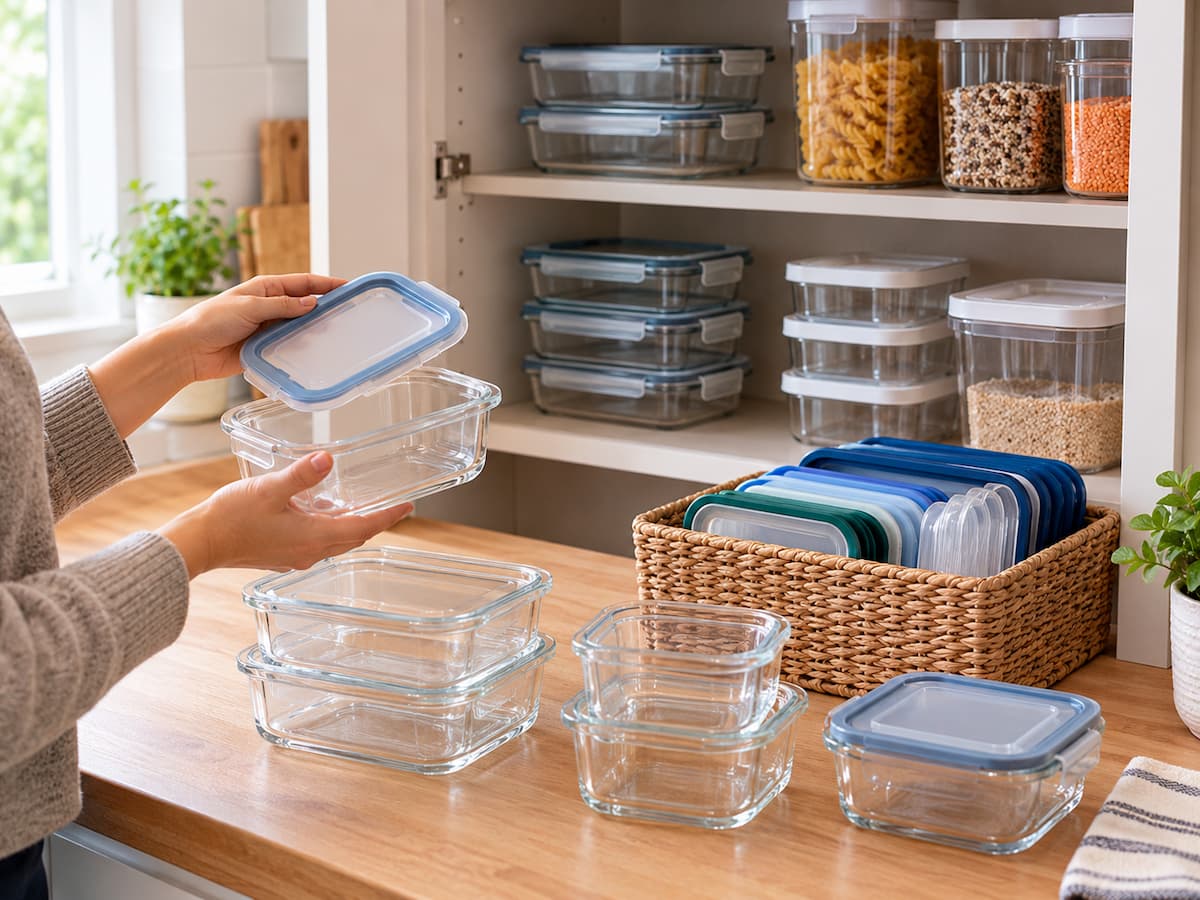
A food storage cupboard can look perfectly organised until you need one container. Then the search begins: one lid is hiding behind a stack of containers, another belongs to an entirely different size, and the container you want is buried at the back.
The problem usually is not a lack of storage space. It is that containers and lids are being treated as one large pile instead of as a system. Different shapes, sizes, lid styles, and nesting abilities can make a cupboard difficult to manage even when it contains only a modest collection. A workable system should make three things easy: finding a matching container and lid, returning them to the right place after washing, and seeing what you actually have before reaching for another container.
Start By Sorting Containers Into Useful Groups
Before buying organisers or rearranging shelves, take everything out of the cupboard or drawer. Put the containers, lids, and any loose pieces where you can see them. This gives you an opportunity to separate items according to how they actually function rather than how they happen to be stored.
Create a few simple groups:
- Containers with matching lids
- Containers with missing lids
- Lids with no obvious container
- Containers that nest inside one another
- Containers that do not nest well
- Special-purpose pieces, such as divided containers
- Damaged or unusable pieces
Do not assume that every loose lid has a matching container somewhere in the cupboard. If you cannot identify a match after checking your collection, set it aside rather than allowing it to remain part of the everyday storage system. The same applies to containers without lids. A container that is only occasionally useful may deserve a different storage location from the pieces you use every week. The goal of this first step is not to throw things away. It is to understand the collection.
Match Containers With Their Lids Before Organising Them
One of the most common causes of container chaos is storing all the containers together while putting all the lids somewhere else. That approach saves space in some cupboards, but it creates a matching problem every time you need to use one. Instead, identify which lids belong to which containers. You do not necessarily need to store every container with its lid physically attached, but the matching system should be obvious.
For example, if you have several rectangular containers of different sizes, group the lids according to those sizes rather than placing every rectangular lid in a single deep stack. A useful test is simple: Can you find a lid for a container without having to test five or six lids first?
If the answer is no, the storage arrangement still needs work.
Let Containers Nest, But Do Not Force Them To
Nesting is one of the easiest ways to reduce the space required by food containers. Smaller containers can sit inside larger containers, allowing several pieces to occupy roughly the same footprint. However, not every collection nests efficiently. Containers with different shapes may become difficult to remove when stacked. A very tight group can also make it hard to identify the size of the container at the bottom.
A practical nesting arrangement might look like this:
Large → medium → small
Place containers of the same shape together when possible. Keep the smallest pieces toward the inside and the largest pieces toward the outside. Avoid creating one enormous tower of unrelated containers. If removing one container requires lifting the entire stack, the arrangement may save shelf space while making everyday use harder. A slightly less compact stack that you can access quickly is often more useful than maximum compression.
Store Lids Differently From Containers
Lids usually create more organisational trouble because they are flat, flexible, and difficult to stack neatly. Containers naturally occupy vertical space. Lids tend to spread horizontally unless they have somewhere to stand. If you have enough room, store lids vertically rather than creating a tall pile. A simple divider can keep different lid sizes separated so that you can scan them from the front.
For example, you might create sections for:
- Small round lids
- Large round lids
- Small rectangular lids
- Large rectangular lids
- Speciality lids
The exact categories depend on your collection. There is no advantage in creating ten divisions for a cupboard containing twelve lids. The useful principle is to group by the feature that helps you identify a match quickly. For some kitchens, that feature is shape. For others, it will be size. If several lids look nearly identical, grouping them by container family may work better.
Keep Similar Shapes Together
Shape is often more useful than size when organising containers. A round container cannot usefully share a lid with a square container, even if their capacities are similar. Rectangular and square containers may also use different lid designs. Keeping similar shapes together reduces the amount of searching required.
A cupboard might therefore have one area for rectangular containers, another for square containers, and another for round containers. Within each group, organise from larger to smaller or by the frequency with which you use them. This is especially helpful when containers are stored without their lids attached. You can find the right container family first and then locate the corresponding lid section.
Consider How You Actually Use The Containers
A storage system should reflect your cooking habits rather than an idealised kitchen. If you regularly store leftovers, the containers you reach for most often should be easy to access. They should not be buried beneath speciality pieces that are used only a few times a year.
You might divide your collection into:
1. Everyday containers:
The sizes are used for leftovers, packed lunches, chopped ingredients, or storing opened food.
2. Occasional containers:
Larger pieces are used for bigger batches or less frequent storage needs.
3. Special-purpose containers:
Divided lunch boxes, unusually large containers, or pieces designed for particular uses.
This does not mean everyday containers must always sit at eye level. The important part is reducing unnecessary handling. If you repeatedly use the same three or four sizes, build the cupboard around them.
Give Lids A Dedicated Home
A dedicated lid area makes a surprisingly large difference. Without one, lids tend to migrate. Some end up inside containers, some are stacked on top of other lids, and some slide behind shelves. A dedicated section can be as simple as a narrow compartment, a divider inside a drawer, or a small bin that holds lids vertically.
The storage solution does not need to be specifically marketed as a food-container organiser. Any clean, stable divider that keeps lids separated and accessible can serve the same basic purpose. The key is preventing the lids from spreading across the entire storage area.
Do Not Make The Lid Section Too Deep
Deep containers can hide lids at the back. If you have to pull out the front row to reach the lid you need, you have recreated the same problem in a different form. A shallow, visible arrangement is often easier to maintain than a deep pile. If a drawer is available, laying lids in a single visible layer can work particularly well. If you use a cupboard shelf, standing them upright may make better use of the available height. Choose the arrangement that lets you see the majority of the collection without unpacking it.
Store Containers According To Their Shapes
Different shapes behave differently in storage.
1. Rectangular Containers
Rectangular containers often make efficient use of shelf space because their straight sides can sit closely together. Keep similar widths together where possible. If several containers have different heights, nesting them by size can reduce the number of separate stacks.
2. Square Containers
Square containers can usually form compact stacks, but mixing several brands or lid designs may make matching difficult. If the containers have interchangeable-looking lids that are actually different, keep each compatible family together.
3. Round Containers
Round containers can be awkward because they leave unused spaces around them when placed beside square or rectangular pieces. It can therefore be useful to give round containers their own section rather than trying to fit them into every available gap.
4. Tall Containers
Tall containers may be useful for certain foods but can be inconvenient on low shelves. Store them where their height does not interfere with reaching other pieces. If a tall container forces you to move several items every time you need something behind it, you are not using the space efficiently.
Do Not Store Every Lid Inside A Container
Putting a lid inside its matching container sounds convenient, but it can waste some of the nesting space that makes container collections compact. It can also create a problem when several containers are stacked. The lids become trapped inside the containers instead of being immediately available.
For a small collection, keeping lids attached may be perfectly reasonable. For a larger collection, separate but organised lid storage often makes better use of the space. There is no single correct method. The right choice depends on whether your priority is maximum nesting, fast access, or keeping each set visibly together.
Create A Simple Return System After Washing
Organisation tends to fail after the first busy week, not on the day you arrange the cupboard. The reason is usually the return process. Clean containers and lids come out of the drying area at different times. If there is no obvious place for them to go, they get placed wherever there is an empty spot.
That is how a carefully arranged cupboard gradually turns back into a mixed pile. Give both parts of the collection an obvious destination. When a container is dry, it goes into its container group. When a lid is dry, it goes into the appropriate lid section. If several people use the kitchen, the system should be simple enough that another person can understand it without asking where everything belongs. A complicated organisation scheme is difficult to maintain. A visible one is much more likely to survive normal kitchen use.
Use the Container Size That Matches The Job
Organisation is easier when you avoid accumulating containers simply because they are available. If you regularly find yourself using a very large container for a small amount of food, consider whether a smaller size would serve the purpose better. Likewise, repeatedly forcing large portions into undersized containers can create unnecessary clutter because you need multiple pieces.
The aim is not to have containers in every possible size. It is to have a useful range that matches the way food is normally stored in your kitchen. When you notice that one size is constantly unused while another is always in demand, that is useful information about your collection.
Watch For Collections That Have Become Too Large
Sometimes the storage problem is not really an organisation problem. If you have accumulated containers from takeout meals, old sets, replacements, mismatched pieces, and several different brands, the collection may simply contain more pieces than the cupboard can comfortably handle. You do not need to decide this immediately. After matching everything, look at what remains.
Ask:
- Which sizes do I actually use?
- Which pieces are repeatedly left untouched?
- Are there many lids that fit only one rarely used container?
- Are several containers performing exactly the same job?
- Are damaged pieces taking up useful space?
This kind of review can reveal why the cupboard keeps becoming crowded despite repeated reorganising.
Avoid Buying Organisers Before Measuring the Space
A storage accessory can solve a specific problem, but buying one before understanding the cupboard can create another layer of clutter. Measure the shelf, drawer, or cabinet area first. Pay attention to usable height, depth, and width—not just the overall dimensions. Then consider what needs to be stored there.
For example, a tall shelf divider may be useful for lids but unsuitable if the shelf height is too low. A large storage bin may keep small lids together but make the individual lids harder to see. The organiser should make the existing system easier to use. It should not become another object that needs its own storage strategy.
Think About Accessibility, Not Just Appearance
A cupboard can look beautifully arranged and still be inconvenient. Suppose all the lids are neatly arranged, but the most frequently used ones are at the back. Or suppose containers are perfectly nested, but reaching the smallest one requires removing six others. That is visual organisation without functional organisation.
A practical system should answer three questions quickly:
- Where is the container I need?
- Where is its matching lid?
- Where does each piece go when I am finished?
If those answers are obvious, the cupboard is doing its job.
What To Do With Unmatched Lids
An unmatched lid deserves its own temporary location rather than being mixed into the main collection. Place it in a small holding area and check whether its container turns up later.
If it remains unmatched after you have had a reasonable opportunity to find it, decide whether keeping it serves a real purpose. The same approach works in reverse for containers without lids. This prevents one uncertain piece from disrupting the organisation of the entire cupboard. It also avoids the common cycle of keeping every stray lid forever because its matching container might still exist.
A Simple Layout For A Typical Kitchen Cupboard
If you are starting from scratch, try a straightforward arrangement:
1. Upper or easiest-to-reach area:
Frequently used containers and the lids that match them.
2. Main shelf:
Nesting stacks arranged by shape and size.
3. Side or narrow section:
Lids are stored vertically and separated by shape or container family.
4. Less accessible area:
Large, speciality, or occasional-use containers.
5. Small holding area:
Unmatched pieces waiting to be identified.
The exact layout will vary with the cupboard. The important idea is to give each type of item a predictable home. If your kitchen has drawers instead of deep cupboards, use the same principles horizontally: containers grouped by shape, lids separated and visible, and frequently used sizes kept within easy reach.
When Your Storage System Stops Working
You do not need to reorganise everything every time the cupboard becomes slightly untidy. Instead, look for the specific failure.
- If lids are scattered, improve the lid section.
- If containers are difficult to remove, change the nesting arrangement.
- If one size is constantly buried, move it to a more accessible location.
- If unmatched pieces keep accumulating, create a temporary holding area and review them periodically.
This approach is more sustainable than repeatedly emptying the entire cupboard without identifying what caused the disorder. For readers who use several containers while preparing and storing food from multiple dishes, organisation can also be connected to the wider kitchen workflow. Planning which foods will be stored, when they will be portioned, and how many containers are needed can prevent a clean cupboard from becoming overloaded after a large cooking session.
A Practical Container-and-Lid System To Try
If you want a simple starting point, use this sequence:
- Empty the storage area completely.
- Match every container with its lid.
- Separate unmatched pieces.
- Group containers by shape.
- Nest-compatible containers by size.
- Create a dedicated lid section.
- Keep frequently used items easy to reach.
- Store speciality pieces separately.
- Leave enough space to remove items without disturbing the entire stack.
- Please return clean pieces to the same sections each time.
After using the system for a week or two, pay attention to where it breaks down. Those observations are more useful than trying to create a perfect arrangement on the first attempt.
The Goal Is Faster Retrieval, Not A Perfect Cupboard
Food-container organisation is successful when it makes everyday cooking and food storage easier. You should not have to dig through a pile of lids to pack leftovers. You should not have to remove an entire stack just to reach a small container. And you should not have to remember a complicated storage system every time you unload the drying rack.
A sensible arrangement gives containers and lids clear homes, uses nesting where it genuinely helps, and keeps the pieces you use most often accessible. If you regularly find yourself with a collection of unmatched containers, scattered lids, or storage problems that keep returning, the Cooking Problem Fixer can also be a useful starting point for working through practical kitchen problems. It should complement your observation of what is making the kitchen difficult to use, rather than replace it.
Conclusion
The easiest way to stop losing food container lids is to stop treating the collection as one large pile. Match the pieces first, group containers by shape, nest only the ones that nest well, and give lids a dedicated place where you can actually see them. Keep frequently used sizes accessible and separate speciality or unmatched pieces from the everyday collection.
Most importantly, organise around the way your kitchen operates. A slightly less compact cupboard that lets you grab the right container and lid immediately is more useful than a perfectly packed cupboard that has to be unpacked every time you need something.
FAQs
1. Should food storage containers be stored with their lids on?
They can be, but it is not always the most space-efficient approach. Keeping lids attached makes matching simple, while storing containers separately allows them to nest more efficiently. If space is limited, separate storage can work well as long as the lids have a dedicated, organised section.
2. Is it better to stack food container lids or store them vertically?
Vertical storage usually makes individual lids easier to see and retrieve, particularly when you have several different sizes. A horizontal stack can work for a small collection, but deeper stacks tend to make the lower lids harder to access.
3. How should I organise containers that are different shapes?
Group them by shape first, then arrange each group by size or frequency of use. Keeping round, square, and rectangular containers separate reduces the number of possible lid matches you need to verify
4. What should I do with containers that have no lids?
Set them aside rather than mixing them into your main collection. If they are useful for another purpose, you can keep them separately. If they serve no practical purpose and have become permanent clutter, you can decide whether they still deserve storage space.
5. How can I stop food container cupboards from becoming messy again?
Keep the return process simple. Assign containers and lids clearly defined places and put them back in those places after washing. If the cupboard repeatedly becomes disorganised, identify the specific problem—such as inaccessible stacks, too many pieces, or poorly grouped lids—and change that part of the system.
6. How many food storage containers should I keep?
There is no useful universal number. A better guide is how much you regularly use and whether your collection fits comfortably into its designated storage area. If you constantly have unused containers while running short of a few particular sizes, you may be better off with fewer, more useful pieces.