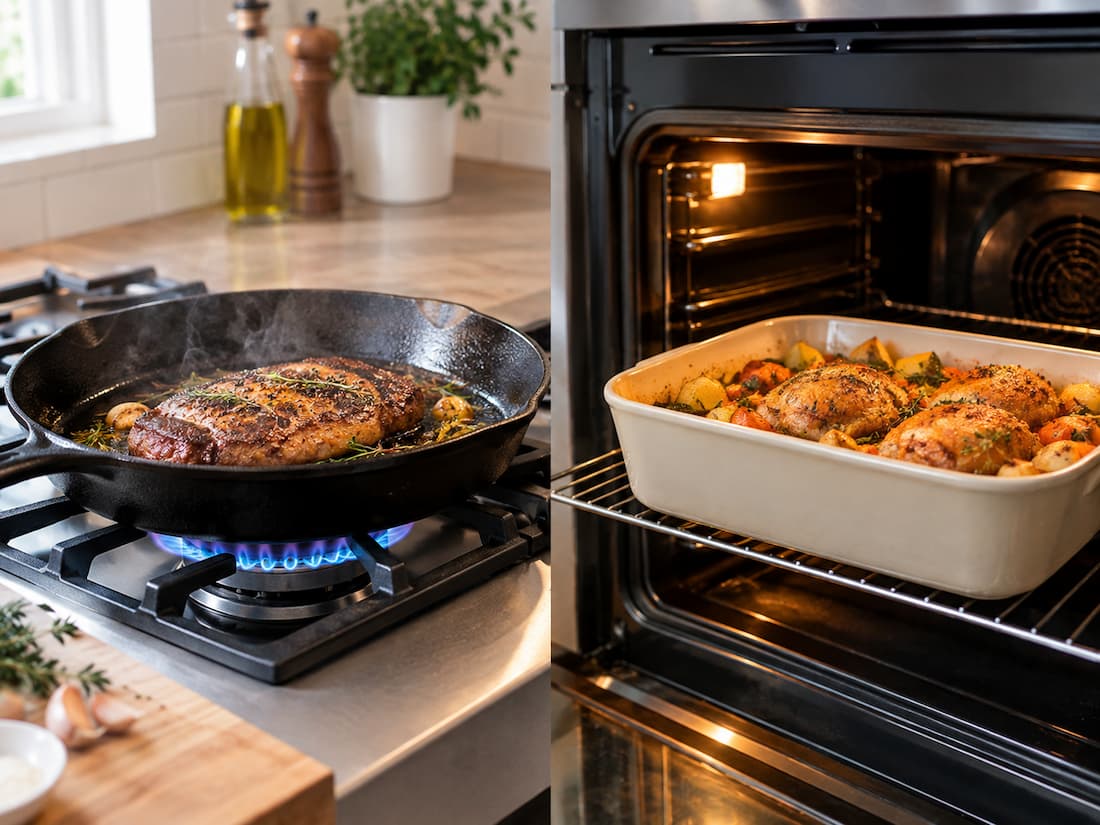
When a recipe says to cook something over direct heat or move it away from the heat source, the difference is more important than it may first appear. Two foods can be cooked in the same pan or grill, at the same temperature setting, yet respond very differently depending on how directly the heat reaches them.
Direct heat is useful when you want rapid browning, searing, crisping, or quick cooking. Indirect heat is useful when the food needs gentler, more even heating or when the outside would otherwise cook too quickly. Knowing which approach fits the food can prevent a familiar set of problems: a dark exterior with an undercooked centre, vegetables that scorch before they soften, or delicate food that dries out before it is ready. The useful skill is not to memorise two definitions. It is about learning to recognise how heat reaches the food and what that means for the result. Once you understand that relationship, you can make better decisions with a frying pan, oven, grill, stovetop, or other everyday cooking setup.
What Direct Heat Actually Means
Direct heat means the food is positioned so that it receives strong heat from the primary heat source with relatively little separation. On a stovetop, a pan sitting directly over an active burner is a straightforward example. On a grill, food placed directly above the burning fuel or active heating element is receiving direct heat. In an oven, the situation can be less obvious because hot air surrounds the food, but food placed very close to a strong heating element can experience a more intense direct heating effect.
The important point is that direct heat is about the relationship between the food and the heat source, not simply whether the cooking method is called grilling, frying, roasting, or baking. Direct heat tends to make the surface of food change quickly. Such results can be precisely what you want when developing a browned crust on a steak, crisping the surface of vegetables, or quickly cooking a thin piece of food. It can also become a problem when the outside takes much less time than the centre.
Direct Heat Is Often About Speed
Imagine a thick piece of chicken placed over a strong burner or grill area. The surface closest to the heat can brown relatively quickly, while the centre takes considerably longer to heat. If the heat remains very intense throughout the cooking process, you may reach a point where the exterior looks finished while the interior still needs more cooking. The same principle applies to many other foods. A thick potato, a large piece of meat, or a substantial vegetable does not heat through at the same rate that its surface changes.
Direct heat therefore works particularly well when:
- The food is relatively thin.
- A browned or crisp exterior is desirable.
- The food cooks quickly.
- You need to develop the surface colour.
- The food can tolerate relatively strong heat without burning.
The challenge is knowing when direct heat has done its job.
Indirect Heat Changes Where the Cooking Pressure Happens
Indirect heat means the food is not positioned directly over the strongest part of the heat source. Instead, it cooks through surrounding hot air, radiant heat from nearby surfaces, or heat transferred from another part of the cooking environment. A classic grill example is a two-zone setup. One side provides strong heat, while the other side is away from the active flame or main heating area. Food can be started over the hotter area and then moved to the cooler side.
This does not mean the food stops cooking. It means the intensity and path of heat reaching it have changed. That distinction is useful for larger pieces of food. Instead of continually exposing the surface to the strongest available heat, you can allow the food to continue heating in a gentler environment.
Indirect heat is particularly useful when:
- The food is thick.
- The outside browns faster than the centre cooks.
- A long cooking period is needed.
- Strong heat could scorch the exterior.
- You want more separation between browning and finishing.
Indirect heat is therefore not just “low heat.” A food can still be cooking quite actively while positioned away from the strongest direct source.
Direct and Indirect Heat Can Be Used Together
One of the most useful ideas is that direct and indirect heat are not competing cooking methods. They can be stages of the same cooking process. A common approach with thick food is to use stronger heat when surface browning is useful and gentler heat afterward when the centre needs more time.
For example, a thick piece of meat might first receive direct heat to develop surface colour and then be moved away from the strongest heat so it can continue cooking without exposing the exterior to the same intensity. The reverse can also make sense. A food may spend most of its cooking time in a gentler environment and receive direct heat near the end to improve browning or crispness. This separation is valuable because browning and heating the centre are not always best achieved under exactly the same conditions.
A useful question is:
What does the food need at this moment: faster surface cooking or more gradual heating through the center?
That question is often more useful than simply asking whether the burner or grill should be set to “high” or “low”.
Why Thickness Matters So Much
Thickness changes how direct and indirect heat should be used, as heat must travel from the outside toward the centre. A thin slice of food can heat through relatively quickly. Strong direct heat may therefore be practical, as the centre does not have a long distance to travel before it becomes hot. A thick piece has a different problem. The surface can become browned, dry, or even burnt while the centre is still catching up. This phenomenon is why the same heat level can produce very different results depending on the size and shape of the food.
Consider two pieces of potato. Thin slices can be cooked directly in a hot pan and may brown before they become excessively dry. A large whole potato placed in the same environment is much more likely to develop a heavily cooked exterior long before its centre is ready. The difference is not necessarily a failure of the cooking method. The food simply has different heat-transfer requirements.
When deciding how strongly to expose food to heat, consider:
- Thickness: thicker foods generally need more time for heat to reach the centre.
- Surface area: thin or widely cut pieces expose more food to the heat source.
- Moisture: water within food affects how quickly the food surface can become very hot.
- Density: compact foods can take longer to heat through.
- Starting temperature: chilled food and room-temperature food do not begin from the same thermal starting point.
- Shape: an irregular piece may cook unevenly because different parts are exposed differently.
These factors explain why a cooking instruction cannot always be applied mechanically.
The Pan Can Create Both Direct and Indirect Heat Zones
A single pan does not necessarily have identical heat everywhere. The area directly above the burner generally receives the strongest heat input, but the entire cooking surface can distribute that energy. Pan material, thickness, size, shape, and burner position all affect how heat spreads. This means you can sometimes create practical differences within the same pan.
For example, if one area of a large pan is becoming too aggressive for a delicate ingredient, moving the ingredient to another area may reduce its exposure. This is not the same as turning the burner off, but it can change the immediate cooking conditions. A pan also continues transferring heat after food is moved. That is one reason you should judge the food itself rather than assuming every location in the pan behaves identically. If food repeatedly browns much faster on one side of a pan, the problem may not be your stirring technique. The pan and heat source may simply be distributing heat unevenly.
This is one situation where the Cooking Problem Fixer can be useful as a practical troubleshooting starting point when you are trying to identify why a dish is cooking unevenly or developing unwanted texture.
Direct Heat Is Not Automatically “Better” for Browning
Browning requires the surface to become sufficiently hot and dry for the appropriate reactions to occur, but simply increasing the heat is not a universal solution. If food contains substantial surface moisture, some of the available heat initially goes toward evaporating that water. If the surface is crowded with other ingredients releasing moisture, browning can also become more difficult.
This creates an important distinction:
More heat does not always mean better browning.
If the food is exposed to excessive heat for too long, the surface may go from lightly browned to burnt before the rest of the food is ready. The goal is to provide enough heat for the desired surface change while still allowing the food to reach the desired internal state. That is why direct heat is often best thought of as a tool rather than a default setting.
When Indirect Heat Helps Prevent Scorching
Some foods have surfaces that are particularly vulnerable to intense heat. Foods containing sugars can darken quickly. Marinades or sauces on the exterior can also burn before the underlying food has finished cooking. Delicate vegetables may soften more slowly than their exposed edges darken.
Moving such food away from the strongest heat can give the interior more time while reducing the intensity of surface heating. This is especially useful when a food has already developed enough colour. Once the surface looks the way you want, continuing to apply maximum direct heat may not provide much additional benefit. It may simply increase the chance of scorching. A useful visual cue is to ask whether the outside is progressing faster than the inside. If it is, changing the heat exposure may be more useful than simply continuing to cook.
Grilling Makes the Difference Easy to See
Grilling is one of the clearest examples of direct and indirect heat because you can deliberately arrange the cooking area into different zones. With a two-zone setup, one section has stronger direct heat, while another section has less direct exposure. This creates flexibility.
A thin vegetable skewer may need only direct heat for a relatively short period. A thicker food may benefit from initial browning over direct heat followed by slower cooking away from the strongest source. The arrangement also gives you somewhere to move food when flare-ups occur or when the surface is becoming darker than intended. That does not mean indirect heat is always safer or automatically better. It is simply another level of control. The key is to avoid thinking of the grill as having only one temperature. Different positions can produce meaningfully different cooking conditions.
The Oven Is More Complicated Than a Simple Direct/Indirect Label
Ovens do not divide as neatly into direct and indirect heat zones as a grill can. Food in an oven is heated by a combination of hot air movement, radiation from hot surfaces and heating elements, and conduction through the pan. The exact balance varies with the oven and cooking position. Still, the direct-versus-indirect idea remains useful.
Food placed very close to a strong heating element can brown or darken faster than an item positioned farther away. A pan near the top of an oven may receive stronger radiant heat from an upper element, while another position may expose it differently. This is one reason moving a pan within an oven can sometimes change browning without changing the recipe itself. However, oven position should not be treated as a guaranteed substitute for changing temperature. The effect depends on the oven design and what is being cooked.
If the surface is darkening too quickly, the better solution may involve adjusting the temperature, changing the position, shielding part of the food, or changing the cooking method, rather than simply assuming that one oven rack always equals “indirect heat.”
Direct Heat Works Differently With Different Foods
There is no single correct heat arrangement for every ingredient.
Thin Vegetables
Thin slices of zucchini, peppers, onions, or similar vegetables can respond well to direct heat because they have relatively little distance between the surface and centre. The main concern is controlling how quickly the exterior colours develop in relation to the desired tenderness.
Thick Vegetables
Large pieces of potato, squash, or other dense vegetables may need more time. Strong direct heat can cause excessive surface browning before the centre reaches the desired texture. A gentler cooking environment, or a combination of direct and indirect exposure, can provide better control.
Meat
The size and shape of the meat matter considerably. A thin cut can often tolerate direct heat for much of its cooking. A thick piece presents a greater difference between surface cooking and centre heating. The important distinction is that surface appearance alone cannot tell you whether meat is safely cooked. When food safety is involved, use an appropriate food thermometer and reliable food-safety guidance rather than judging doneness from browning alone.
Delicate Foods
Foods that scorch easily may benefit from less intense direct exposure, especially after their surface has reached the desired colour. The same principle applies to foods with sugary coatings or sauces: the coating can change much faster than the underlying food.
A Simple Way to Decide Which Heat to Use
When you are unsure, work through four questions.
1. Does the Food Need Fast Surface Browning?
If yes, direct heat may be useful.
Think about searing, crisping, or developing colour on a relatively short cooking surface.
2. Is the Food Thick Enough That the Centre Needs Much More Time?
If so, consider reducing direct exposure once the surface has developed enough colour.
This is where indirect heat can become useful.
3. Is the Outside Darkening Too Quickly?
If the answer is yes, continuing with the same heat exposure is unlikely to solve the problem. Move the food away from the strongest heat source, reduce the heat, or otherwise change the cooking conditions.
4. What Result Are You Actually Trying to Achieve?
Do you need:
- browning?
- crispness?
- tenderness?
- gentle heating?
- even cooking?
- a combination of these?
The answer should guide the heat arrangement.
This approach is more reliable than treating “high heat” or “low heat” as universal instructions.
Common Mistakes With Direct and Indirect Heat
- Keeping Food Over Strong Heat Because It Has Not Finished Yet
- Treating Indirect Heat as No Heat
- Using the Same Heat Exposure for Every Size of Food
- Chasing Colour Instead of the Desired Final Result
- Moving Food Too Often Without a Reason
Direct and Indirect Heat Are About Control, Not Strict Rules
Cooking instructions sometimes make direct and indirect heat sound like completely separate techniques. In practice, they are best understood as ways to control how strongly and where heat reaches the food. You can use direct heat to begin browning, indirect heat to continue cooking, and direct heat again if the surface needs another brief burst of colour. The exact sequence depends on the food, its size, the equipment, and the desired result.
You also do not need specialised equipment to start thinking this way. On a stovetop, changing burner intensity or moving food within a pan can alter its exposure. On a grill, you can create hot and cooler zones to give yourself more deliberate control. In an oven, rack position and cooking temperature can affect how quickly the surface changes. The important habit is to observe the food and adjust the heat based on what is actually happening.
When Direct and Indirect Heat Are Most Useful Together
A useful mental model is to divide cooking into two broad jobs:
- Surface work: browning, crisping, and developing colour.
- Interior work: allowing the centre to heat or soften without excessively darkening the outside.
Direct heat is often effective at the first job. Indirect heat can be valuable for the second. They do not always need to happen separately, and not every food requires both. But when a dish has a surface that cooks much faster than its centre, separating those jobs gives you much more control.
That is the practical reason this distinction matters. You are not choosing between two competing cooking philosophies. You are deciding how much heat the food needs, where that heat should come from, and whether the surface and centre need different treatment at different stages.
The Practical Takeaway
Direct and indirect heat are simply two ways to control how strongly heat reaches food. Direct heat is particularly useful for fast surface changes such as browning and crisping. Indirect heat becomes valuable when food needs more time to cook through without exposing its surface to the same intensity. The most useful habit is to watch the relationship between the outside and the inside. If the surface is progressing faster than the centre, more intense direct heat may not be the best option. If the surface needs colour and the food can handle strong exposure, direct heat may be just what you need. Once you start thinking about where the heat is coming from, how strongly it reaches the food, and what the food needs at that stage, direct and indirect heat become practical tools for controlling everyday cooking, rather than just terms that appear in specialised recipes.
FAQs
1. Is direct heat the same as high heat?
No. Direct heat describes how closely or directly the food is exposed to the main heat source. High heat describes the intensity of heating. They often occur together, but they are not identical concepts.
2. Can I use indirect heat on a stovetop?
Yes, although it does not work exactly like a two-zone grill. You can reduce direct exposure by lowering the burner, moving the pan or food away from the strongest area, or using another cooking setup that provides gentler surrounding heat.
3. Why does food burn outside while staying undercooked inside?
The surface receives and responds to heat faster than it reaches the centre. This phenomenon is more likely with thick foods and very strong direct heat. Reducing the intensity or finishing with more indirect heat can sometimes provide better control.
4. Is indirect heat always better for thick foods?
Not necessarily. Thick foods may benefit from indirect heat, but direct heat can also be useful for developing surface colour. The best approach often depends on the desired exterior and the amount of time needed for the centre to cook.
5. Can direct heat make vegetables cook unevenly?
Yes. If some parts are much closer to the heat source or are thinner than others, they can brown or soften at different rates. Cutting food into reasonably consistent pieces and adjusting its position can help.
6. How do I know when to move food from direct to indirect heat?
A practical cue is when the exterior has reached the colour or surface texture you want but the centre still needs more cooking. At that point, reducing the intensity of surface heating can help prevent the outside from progressing too far.